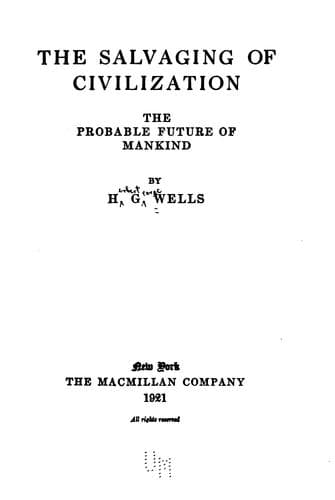
The Salvaging of CivilizationWells, H. G. (Herbert George)
Philosophy
The Salvaging of Civilization
Wells, H. G. (Herbert George)
Civilization, Modern -- 20th century; Education
You see that what I am suggesting here is in effect that we should take
our colleges, so far as they are segregations of young people for
general adolescent education, and break them as a cook breaks eggs--and
stir them up again into the general intellectual life of the community.
Coupled with that there should, of course, be a proposal to restrict the
hours of industrial work or specialized technical study up to the age of
twenty, at least, in order to leave time for this college stage in the
general education of every citizen of the world.
The idea has already been broached that men and women in the modern
community are no longer inclined to consider themselves as ever
completely adult and finished; there is a growing disposition and a
growing necessity to keep on learning throughout life. In the worlds of
research, of literature and art and economic enterprise, that adult
learning takes highly specialized forms which I will not discuss now;
but in the general modern community the process of continuing education
after the college stage is still evidently only at a primitive level of
development. There are a certain number of literary societies and
societies for the study of particular subjects; the pulpit still
performs an educational function; there are public lectures and in
America there are the hopeful germs of what may become later on a very
considerable organization of adult study in the Lyceum Chautauqua
system; but for the generality of people the daily newspaper, the Sunday
newspaper, the magazine and the book constitute the only methods of
mental revision and enlargement after the school or college stage is
past.
Now we have to remember that the bulk of this great organization of
newspapers and periodicals and all the wide distribution of books that
goes on to-day are extremely recent things. This new nexus of print has
grown up in the lifetime of four or five generations, and it is
undergoing constant changes. We are apt to forget its extreme newness in
history and to disregard the profound difference in mental conditions it
makes between our own times and any former period. It is impossible to
believe that thus far it is anything but a sketch and intimation of what
it will presently be. It has grown. No man foresaw it; no one planned
it. We of this generation have grown up with it and are in the habit of
behaving as though this nexus had always been with us and as though it
would certainly remain with us. The latter conclusion is almost wilder
than the former.
Public-domain text, read in full here on John Shaqi.
Reviews
Reviews
No reviews yet
Be the first to share your thoughts on this work.
Elsewhere in the archive
Join the Discussion
Join the discussion
Sign in to leave a comment or review.
Sign InorCreate an account