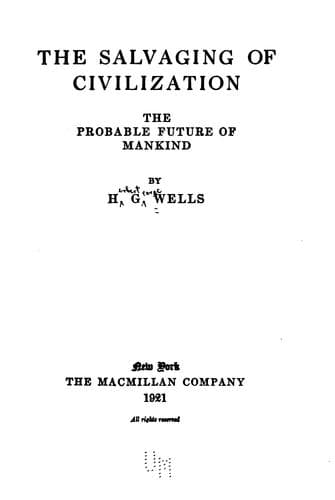
The Salvaging of CivilizationWells, H. G. (Herbert George)
Philosophy
The Salvaging of Civilization
Wells, H. G. (Herbert George)
Civilization, Modern -- 20th century; Education
Educational reformers seem always to be looking at education from the
point of view of the individual scholastic enterprise and of the
individual pupil, and hardly ever from the point of view of a public
task dealing with the community as a whole. For all practical purposes
this makes waste paper of a considerable proportion of educational
literature. This literature, the reader will find, is pervaded by
certain fixed ideas. There is a sort of standing objection to any
_machining_ of education. There is, we are constantly told, to be no
syllabus of instruction, no examinations and no controls, no prescribed
text-books or diagrams because these things limit the genius of the
teacher. And this goes on with a blissful invincible disregard of the
fact that in nine hundred and ninety-nine cases out of the thousand the
genius of the teacher isn't and can't be there. And also of the fact
that this affair of elementary education has in its essentials been done
over and over and over again for thousands of millions of times. There
ought to be as much scope left for genius and originality in ordinary
teaching as there is for genius and originality in a hen laying an
ordinary egg.
These educational idealists are always disregarding the fundamental
problem of educational organization altogether, the problem of economy,
economy of the most precious thing of all, _teaching power_. It is the
problem of stretching the competent teacher over the maximum number of
pupils, and that can be done only by the same methods of economy that
are practised in every other large-scale production--by the
standardization of everything that can be standardized, and by the use
of every possible time and labour-saving device and every possible
replacement of human effort, not in order to dispense with originality
and initiative but in order to conserve them for application at their
points of maximum efficiency.
Public-domain text, read in full here on John Shaqi.
Reviews
Reviews
No reviews yet
Be the first to share your thoughts on this work.
Elsewhere in the archive
Join the Discussion
Join the discussion
Sign in to leave a comment or review.
Sign InorCreate an account