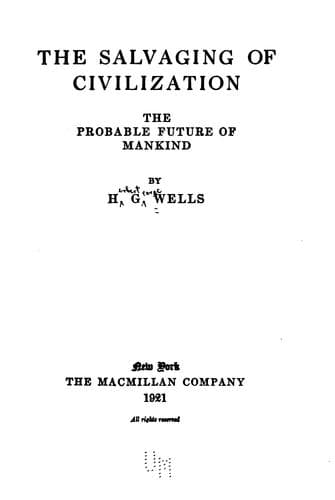
The Salvaging of CivilizationWells, H. G. (Herbert George)
Philosophy
The Salvaging of Civilization
Wells, H. G. (Herbert George)
Civilization, Modern -- 20th century; Education
I have said that a disregard of the possibilities of wide organization
and its associated economy of effort is characteristic of most
"advanced" educational literature. You will, if you will examine them,
find that disregard working out to its natural consequences in what are
called the "advanced" schools that appeal to educationally anxious
parents nowadays. You will find that these places, often very
picturesque and pleasing-looking places, are rarely prosperous enough to
maintain more than one or two good teachers. The rest of the staff
shrinks from scrutiny. You will find these schools adorned with
attractive diagrams drawn by the teachers, and strikingly original
models and apparatus made by the teachers, and if you look closely into
the matter or consult an intelligent pupil, you will find there are
never enough diagrams and apparatus to see a course through. If you
press that matter you will find that they haven't had time to make them
so far. And they will never get so far. No school, however rich and
prosperous and however enthusiastically run, can hope to make for itself
all the plant and diagrams and apparatus needed for a fully efficient
modern education such as we have sketched out. As well might a busy man
hope to array himself, by his own efforts, with hats, suits and boots
made by himself out of wool and raw hides.
But now I think you will begin to see what I am driving at. It is this:
that if the general level of education is to be raised in our modern
community, and if that better education is to be spread over most of our
community, it is necessary to reorganize education in the world upon
entirely bolder, more efficient, and more economical lines. We are
inexorably limited as to the number of good teachers we can get into the
educational organization, and we are limited as inexorably as to the
quality of the rank and file of our teaching profession; but we are not
limited in the equipment and systematic organization of teaching methods
and apparatus. That is what I want particularly to enlarge upon now.
Think of the ordinary schoolhouse--a mere empty brick building with a
few hat-pegs, a stale map or so, half a dozen plaster casts, a few
hundred tattered books, a blackboard, and some broken chemical
apparatus: think of it as the dingy insufficiency it is! In such a place
the best teacher must needs waste three-fourths of his energies. In such
a place staff and pupils meet chiefly to waste each other's time. This
is the first and principal point at which we can stanch the wastage of
teaching energy that now goes on. Everywhere about the world nowadays,
the schoolhouse is set up and equipped by a private person or a local
authority in more or less complete ignorance of educational
possibilities, in more or less complete disconnectedness, without any of
the help or any of the economy that comes from a centralized mass
production. Let us now consider what we might have in the place of this
typical schoolhouse of to-day.
Public-domain text, read in full here on John Shaqi.
Reviews
Reviews
No reviews yet
Be the first to share your thoughts on this work.
Elsewhere in the archive
Join the Discussion
Join the discussion
Sign in to leave a comment or review.
Sign InorCreate an account