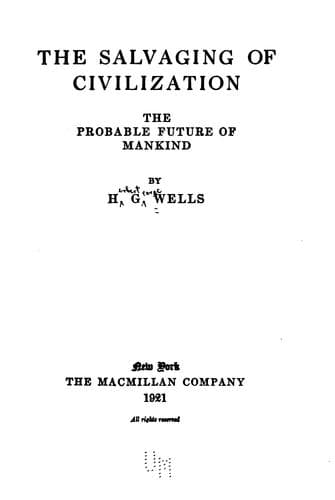
The Salvaging of CivilizationWells, H. G. (Herbert George)
Philosophy
The Salvaging of Civilization
Wells, H. G. (Herbert George)
Civilization, Modern -- 20th century; Education
I suppose that the savage or the barbarian or the peasant in any part of
the world or the uneducated man anywhere would laugh if you told him
that the adult must still learn. But in our modern world--I mean the
more or less civilized world of the last twenty-five centuries or
so--there has grown up a new idea--new, I mean, in the sense that it
runs counter to the life scheme of primitive humanity and of most other
living things--and that is _the idea that one can go on learning right
up to the end of life_. It marks off modern man from all animals, that
in his adult life he can display a sense that there remains something
still to be investigated and wisdom still to be acquired.
I do not know enough history to tell you with any confidence when adult
men, instead of just going about the business of life after they had
grown up, continued to devote themselves to learning, to a deliberate
prolongation of what is for all other animals an adolescent phase. But
by the time of Buddha in India and Confucius in China and the schools of
the philosophers in the Greek world the thing was in full progress. That
was twenty-six centuries ago or more.
Something of the sort may have been going on in the temples of Egypt or
Samaria a score of centuries before. I do not know. You must ask some
such great authority as Professor Breasted about that. It may be fifty
or a hundred centuries since men, although they were fully grown up,
still went on trying to learn.
The idea of adult learning has spread ever since. To-day I suppose most
educated people would agree that so long as we live we learn and ought
to learn--that we ought to develop our ideas and enlarge, correct and
change our ideas.
But even to-day you will find people who have not yet acquired this
view. You will find even teachers and doctors and business men who are
persuaded that they had learnt all that there was to learn by
twenty-five or thirty. It is only quite recently that this idea has
passed beyond a special class and pervaded the world generally--the idea
of everyone being a life-long student and of the whole world becoming,
as it were, a university for those who have passed beyond the schooling
stage.
It has spread recently because in recent years the world has changed so
rapidly that the idea of settling down for life has passed out of our
minds, has given place to a new realization of the need of continuous
adaptation to the very end of our days. It is no good settling down in a
world that, on its part, refuses to do anything of the sort.
Public-domain text, read in full here on John Shaqi.
Reviews
Reviews
No reviews yet
Be the first to share your thoughts on this work.
Elsewhere in the archive
Join the Discussion
Join the discussion
Sign in to leave a comment or review.
Sign InorCreate an account