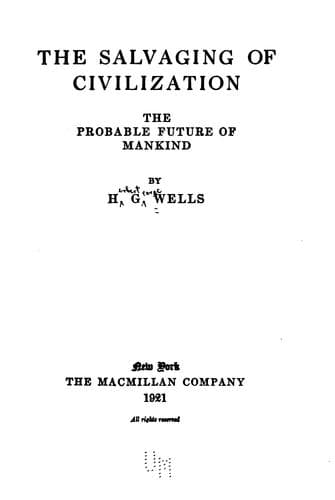
The Salvaging of CivilizationWells, H. G. (Herbert George)
Philosophy
The Salvaging of Civilization
Wells, H. G. (Herbert George)
Civilization, Modern -- 20th century; Education
But hitherto, before these new ideas began to spread in our community,
the mass of men and women definitely _settled down_. At twelve, or
fifteen, or sixteen, or twenty it was decided that they should stop
learning. It has only been a rare and exceptional class hitherto that
has gone on learning throughout life. The scene and field of that
learning hitherto has been, in our Western communities, the University.
Essentially the University is and has been an organization of adult
learning as distinguished from preparatory and adolescent learning.
But between the phase of schooling and the phase of adult learning there
is an intermediate stage.
In Scotland and America that is distinguished and thought of clearly as
the _college stage_. But in England, where we do not think so clearly,
this college stage is mixed up with and done partly at school and partly
in the University. It is not marked off so definitely from the stage of
general preparation that precedes it or from the stage of free
intellectual enterprise that follows it.
Now what should college give the young citizen, male or female, upon the
foundation of schooling we have already sketched out? In practice we
find a good deal of technical study comes into the college stage. The
budding lawyer begins to read law, the doctor starts his professional
studies, the future engineer becomes technical, and the young merchant
sets to work, or should do, to study the great movements of commerce and
business method and organization.
As the college stage of those who do not, as a matter of fact, go to
college, we have now in every civilized country the evening continuation
school, the evening technical school and the works school.
But important as these things are from the point of view of service,
they are not the _soul_--not the real meaning of the college stage.
The soul of the college stage, the most important value about it, is
that in it is a sort of preparatory pause and inspection of the whole
arena of life. It is the educational concomitant of the stage of
adolescence.
The young man and the young woman begin to think for themselves, and the
college education is essentially the supply of stimulus and material
for that process.
It was in the college stage that most of us made out our religion and
made it real for ourselves. It was then we really took hold of social
and political ideas, when we became alive to literature and art, when we
began the delightful and distressful enterprise of finding ourselves.
And I think most of us will agree when we look back that the most real
thing in our college life was not the lecturing and the lessons--very
much of that stuff could very well have been done in the schooling
stage--but the arguments of the debating society, the discussions that
broke out in the classroom or laboratory, the talks in one's rooms about
God and religion, about the state and freedom, about art, about every
possible and impossible social relationship.
Public-domain text, read in full here on John Shaqi.
Reviews
Reviews
No reviews yet
Be the first to share your thoughts on this work.
Elsewhere in the archive
Join the Discussion
Join the discussion
Sign in to leave a comment or review.
Sign InorCreate an account