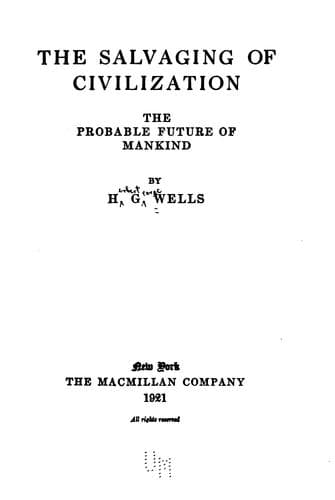
The Salvaging of CivilizationWells, H. G. (Herbert George)
Philosophy
The Salvaging of Civilization
Wells, H. G. (Herbert George)
Civilization, Modern -- 20th century; Education
Could we not do much more than we do to make the broad issues of various
current questions plain and accessible to our students in the college
stage?
For example, there is a vast discussion afoot upon the questions that
centre upon Property, its rights and its limitations. There is a great
literature of Collectivist Socialism and Guild Socialism and Communism.
About these things our young people must know. They are very urgent
questions; our sons and daughters will have to begin to deal with them
from the moment they leave college. Upon them they must form working
opinions, and they must know not only what they themselves believe but,
if our public affairs are not to degenerate into the squalid, obstinate,
hopeless conflicts of prejudiced adherents, they must know also what is
believed by other people whose convictions are different from theirs.
You may want to hush these matters up. Many elderly people do. You will
fail.
All our intelligent students will insist upon learning what they can of
these discussions and forming opinions for themselves. And if the
college will not give them the representative books, a fair statement of
the facts and views, and some guidance through the maze of these
questions, it means merely that they will get a few books in a defiant
or underhand way and form one-sided and impassioned opinions.
Another great set of questions upon which the adolescent want to judge
for themselves, and ought to judge for themselves, are the religious
questions.
And a third group are those that determine the principles of sexual
conduct.
I know that in all these matters, on both sides of the Atlantic, a great
battle rages between dogma and concealment on the one hand and open
ventilation on the other.
Upon the issue I have no doubt. I find it hard even to imagine the case
for the former side.
So long as _schooling_ goes on, the youngster is immature, needs to be
protected, is not called upon for judgments and initiatives, and may
well be kept under mental limitations. I do not care very much how you
censor or select the reading and talking and thinking of the schoolboy
or schoolgirl. But it seems to me that with adolescence comes the right
to knowledge and the right of judgment. And that it is the _task and
duty_ of the college to give matters of opinion in the solid--to let the
student walk round and see them from every side.
Now how is this to be done?
I suggest that to begin with we open wide our colleges to propaganda of
every sort. There is still a general tendency in universities on both
sides of the Atlantic to treat propaganda as infection. For the
adolescent it is not--it is a stimulating drug.
Public-domain text, read in full here on John Shaqi.
Reviews
Reviews
No reviews yet
Be the first to share your thoughts on this work.
Elsewhere in the archive
Join the Discussion
Join the discussion
Sign in to leave a comment or review.
Sign InorCreate an account