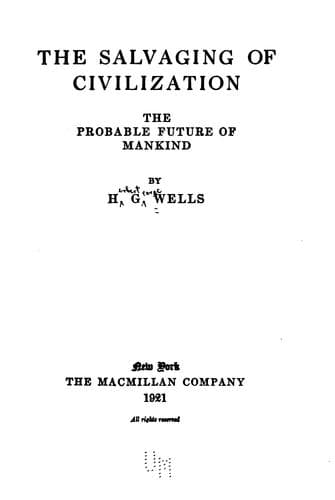
The Salvaging of CivilizationWells, H. G. (Herbert George)
Philosophy
The Salvaging of Civilization
Wells, H. G. (Herbert George)
Civilization, Modern -- 20th century; Education
Now in addition to that I had something else in my own college
course--something of the same sort of thing but better.
I have spoken of myself as under-educated. My schooling was shocking
but, as a blessed compensation, my college stage was rather
exceptionally good. My schooling ended when I was thirteen. My father,
who was a professional cricketer, was smashed up by an accident, and I
had three horrible years in employment in shops. Then my luck changed
and I found myself under one of the very greatest teachers of his time,
Professor Huxley. I worked at the Royal College of Science in London
for one year under him in his great course in zoology, and for a year
and a half under a very good but rather uninspiring teacher, Professor
Judd, the geologist. I did also physics and astronomy. Altogether I had
three full years of science study. And the teaching of biology at that
time, as Huxley had planned it, was a continuing, systematic,
illuminating study of life, of the forms and appearances of life, of the
way of life, of the interplay of life, of the past of life and the
present prospect of life. It was a tremendous training in the sifting of
evidence and the examination of appearances.
Every man is likely to be biassed, I suppose, in favour of his own
educational course. Yet it seems to me that those three years of work
were educational--that they gave a vision of the universe as a whole and
a discipline and a power such as no other course, no classical or
mathematical course I have ever had a chance of testing, could do.
I am so far a believer in a biological backbone for the college phase of
education that I have secured it for my sons and I have done all I can
to extend it in England. Nevertheless, important as that formal college
work was to me, it still seems to me that the informal part of our
college life--the talk, the debates, the discussion, the scampering
about London to attend great political meetings, to hear William Morris
on Socialism, Auberon Herbert on Individualism, Gladstone on Home Rule,
or Bradlaugh on Atheism--for those were the lights of my remote student
days--was about equally important.
If schooling is a training in expression and communication, college is
essentially the establishment of broad convictions. And in order that
they may be established firmly and clearly, it is necessary that the
developing young man or woman should hear all possible views and see the
medal of truth not only from the obverse but from the reverse side.
Now here again I want to put the same sort of questions I have put about
schooling.
Is the college stage of our present educational system anywhere near its
maximum possible efficiency? And could it not be extended from its
present limited range until it reached practically the whole adolescent
community?
Let me deal with the first of these questions first.
Public-domain text, read in full here on John Shaqi.
Reviews
Reviews
No reviews yet
Be the first to share your thoughts on this work.
Elsewhere in the archive
Join the Discussion
Join the discussion
Sign in to leave a comment or review.
Sign InorCreate an account