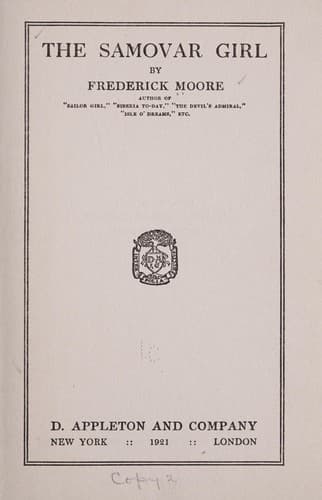
Russia (Federation) -- History -- Revolution, 1917-1921 -- Fiction; Siberia (Russia) -- Fiction
“Thank you,” said Peter, and he rose, and bowed.
“You shall find Kirsakoff,” said Michael, staring at his hand on the
table. “By morning I shall know where he may be found—perhaps. We must
not act hastily.” The palsied head was shaking gently, and the old man
was lost again in thought.
“Yes, yes,” Katerin put in hastily. Peter saw tears in her eyes. She
followed after him as he turned to go back through the rooms, and they
left Michael and Wassili alone.
Peter stopped at his own door, and looking back over Katerin’s shoulder,
saw against the light of the room he had just left, a shadow cross—and
then the figure of Wassili peering after them.
“Good-night,” said Katerin. She seemed nervous and worried. She also had
caught a glimpse of the old _moujik_ outlined against the glow of her
father’s lamp.
Peter seized her hands in sudden impulse and pressed them heartily. “I
cannot tell you of my gratitude, Vashka,” he whispered. “It was you who
helped me in this—and I have waited long! You are going to persuade your
father to tell me where I shall find Kirsakoff!”
She gently drew away from him, and he released her hands.
“I shall do what I can,” she whispered. “But take care—this house is
full of enemies. If we are to defeat the Ataman, be wary. Bolt both your
doors to-night!”
Then she slipped away to her father.
------------------------------------------------------------------------
XX
THE BLOW
PETER, alone once more in his room, found that a strange calmness had
come to him once the secret of his purpose in returning to the Valley of
Despair was in the keeping of two other persons. There was for him in
that fact something of the relief of the confessional. For twenty years
he had nursed in his soul the grievance of his father’s death, and his
own imprisonment—nursed it most secretly, pent it up within his
consciousness, till it seemed that his body had become a kind of culture
tube of germinating hate.
For the first time since he had left Chita as a boy, he found an
easement of his soul burden. These people to whom he had told his story,
understood his deepest emotions regarding his father. No American could
ever have understood fully, Peter was well aware. Prison to an American
implies disgrace, some sort of stain upon the character which is never
fully lived down. But to this old exile, as Peter supposed Kirsakoff to
be, Peter’s story was an honor to him. For the old man had suffered the
horrors of the exile system, mixing, as it did, the highest type of
Russian with the lowest—the thinker with the cutthroat.
Public-domain text, read in full here on John Shaqi.
Reviews
Reviews
No reviews yet
Be the first to share your thoughts on this work.
Elsewhere in the archive
Join the Discussion
Join the discussion
Sign in to leave a comment or review.
Sign InorCreate an account