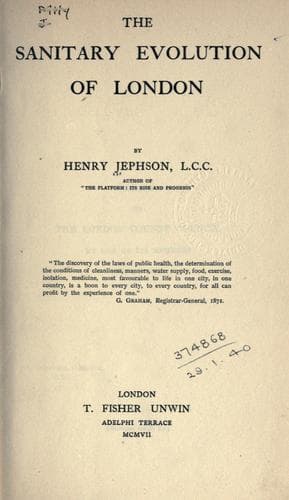
The Sanitary Evolution of LondonJephson, Henry (Henry Lorenzo)
History
The Sanitary Evolution of London
Jephson, Henry (Henry Lorenzo)
Public health -- England -- London
"It cannot be too often impressed upon our minds," wrote one, "that
sickness among the poor is the great cause of pressure upon the rates;
and everything that will tend to diminish the number of sick will be so
much saved to the ratepayers."[78]
"The greater the amount of disease," wrote another, "the larger the
proportion of pauperism."
"Of the causes of pauperism, none are so common as disease and death,"
wrote another.
Indeed, a little consideration must have demonstrated its truth.
Difficult as it was for the individual in health to earn a
livelihood--when sickness fell upon him there was the instant and
complete cessation of his wages, and there were expenses incurred by
his sickness. If he recovered, there had been a long disablement from
work, and a heavy loss. If, however, he died, the community suffered
by the loss of his productive labour, and, where the victim was the
breadwinner of a family, his widow and children but too commonly became
a charge upon the rates.
"High mortality in a district," wrote the Medical Officer of Health for
Clerkenwell (1858), "especially among the poor who are the principal
sufferers, does not relate simply to the dead; the living are also
deeply concerned. Every death in a poor family causes an interruption
to the ordinary remunerative labour, and produces expenses which have
to be paid out of scanty wages. Hence the living suffer from want; the
parish funds must be appealed to; families become parentless, and next
comes crime."
The Medical Officer of Health for Whitechapel (1858) wrote:--
"In the course of time the public will learn that sickness, with its
concomitant evils, viz., the loss of wages, the calls upon clubs and
friendly societies, the increased amount of charitable contributions,
a heavier poor rate, &c., entails more expense upon the community
than would be required to carry out sanitary improvements in widening
streets, converting the culs-de-sac into thoroughfares, and in erecting
more commodious houses for the poor."
And the Medical Officer of Health for the Strand wrote:--
"Of every death which occurs in this district over and above the
ordinary rate of mortality, the number of _cases of illness in excess_
must be a high multiple. And during every attack of severe illness the
patient, whatever his position in life may be, must be maintained--if
wealthy, at his own expense, if poor, at that of the community at
large. And in the latter case, the community at large must thus suffer
a direct loss. _Health is money_, as much as time is money, and sooner
or later sickness must be paid for out of the common fund...."
And the Medical Officer of Health for Shoreditch (1856) wrote:--
Public-domain text, read in full here on John Shaqi.
Reviews
Reviews
No reviews yet
Be the first to share your thoughts on this work.
Elsewhere in the archive
Join the Discussion
Join the discussion
Sign in to leave a comment or review.
Sign InorCreate an account