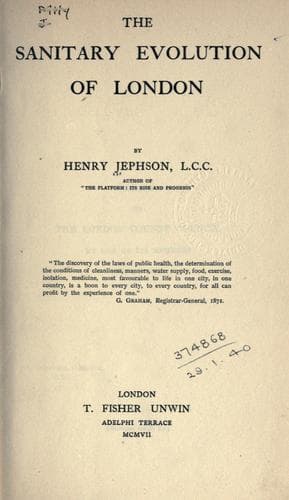
The Sanitary Evolution of LondonJephson, Henry (Henry Lorenzo)
History
The Sanitary Evolution of London
Jephson, Henry (Henry Lorenzo)
Public health -- England -- London
"To communities as well as to individuals there is nothing so
expensive, so fatal to prosperity, as sickness. To a productive and
labouring community, health is the chief estate.... A community is but
a system of individuals--if one portion of that system be disabled by
sickness, every other portion will feel the blow; the whole community
will be taxed to support that part which is rendered incapable of
supporting itself. It is then a plain matter of self-interest, as
well as of solemn obligation, to exercise the most vigilant care in
preserving to the poor their only worldly possession, their health and
capacity for self-support."
Nor did the danger to the great community of London, from the
prevalence of sickness in any particular district, appear to have
received the faintest recognition.
And yet, in the matter of health, and protection from infection, all
classes from the highest to the lowest had equal interest; for disease
commencing or raging in one district is not long in spreading to other
districts.
The Medical Officer of Health for Chelsea (1857-8) wrote:--
"It cannot need any argument to prove that diseases of an epidemic or
infectious nature cannot be arrested in their progress by the imaginary
line drawn around the boundaries of the parish--that the smoke from
the furnaces in Lambeth and Vauxhall must be wafted across the Thames
and influence the health of the inhabitants of Chelsea, if not kept in
check, and that evils of minor importance in Pimlico, on one side, and
Kensington on the other, may be quite as prejudicial to the health of
the neighbours residing on this side of the boundary as to those among
whom they are generated."
That any one locality had a duty to its neighbours, still less to
London as a whole, as well as to the people of its own area, was beyond
the range of the ideas of the vestries and district boards. Indeed, if
their sense of duty did not induce them to look after and safeguard the
people for whose sanitary condition they were immediately responsible,
how could it be expected of them to be influenced by considerations as
to those residing outside their area, and residing many miles away.
And yet, by the very condition of things, this greater responsibility
did exist.
But the great fact that in the vital matter of the public health London
was one great community, the various parts thereof being indissolubly
welded together into one great whole, had not as yet apparently dawned
upon the minds of the newly-created local authorities; nor, indeed,
had Parliament even realised it, for it had left the forty and more
of those authorities full freedom to scatter disease of the deadliest
type from one end of London to the other, and to imperil the lives of
London's inhabitants.
Public-domain text, read in full here on John Shaqi.
Reviews
Reviews
No reviews yet
Be the first to share your thoughts on this work.
Elsewhere in the archive
Join the Discussion
Join the discussion
Sign in to leave a comment or review.
Sign InorCreate an account