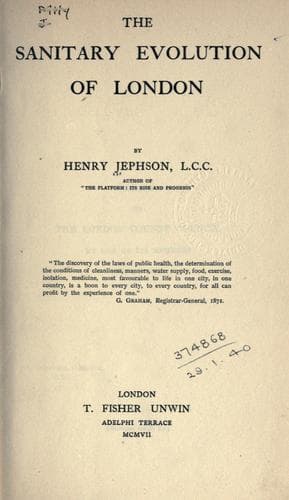
The Sanitary Evolution of LondonJephson, Henry (Henry Lorenzo)
History
The Sanitary Evolution of London
Jephson, Henry (Henry Lorenzo)
Public health -- England -- London
[58] There is in the library of the London County Council an almost
complete set of these annual reports inherited from the Metropolitan
Board of Works. Unless those sent to the Secretary of State, as
directed by the Act, have been preserved, there is no other collection
in existence.
[59] St. Giles'.
[60] Fulham.
[61] Rotherhithe.
[62] Hackney.
[63] Medical Officer of Health, 1856.
[64] "Lungs for London," _Household Words_, vol. i. p. 45, 1850.
[65] P.P. 1852-3, vol. lxxviii. p. 327.
[66] Clerkenwell, 1856.
[67] Fulham, 1857.
[68] Whitechapel, 1857.
[69] St. Giles', 1859.
[70] St. George the Martyr, 1859-60.
[71] Strand, 1859-60.
[72] Clerkenwell, 1860-1.
[73] 14 and 15 Vic. cap. 34.
[74] Shoreditch, 1859-60.
[75] St. Giles', 1857-8.
[76] St. Olave, Southwark, 1856.
[77] Whitechapel, 1857.
[78] Whitechapel.
[79] Population went up from 51,824 in 1851 to 60,278 in 1896.
[80] "The moral and social benefits conferred by these buildings has
been immeasurable," wrote one Medical Officer of Health (St. Pancras).
"They are institutions whose larger acceptance would save the lives
of hundreds, and reclaim the morals of thousands," wrote another.
CHAPTER III
1861-1870
THE Census of 1861 disposed of the various estimates of the population
of London, and of the death-rates in its various parishes, and gave
authoritatively the actual figures.
From 2,363,341 persons in 1851, the population had gone up to 2,808,494
in 1861--an increase not very far short of half a million; and the
number of inhabited houses had increased from 306,064 to 360,065.
The natural growth of the population, or in other words, the excess of
births over deaths, accounted for but part of this increase. The rest
was due to the great stream of immigrants into London, which, notable
previously, "continued to flow thither with unabated force."
The increase was not equally distributed. The population of the
central parts showed a decline. There the great economic forces
were most powerful, and under their influence the population of
the "City" had decreased by more than 15,000: that of Holborn and
St. Martin-in-the-Fields by nearly 2,000 each: that of St. James',
Westminster, by about 1,000, and two or three others slightly.
But elsewhere--east, north, west, south--the increases had been great,
and in some instances remarkable. Poplar had increased in the decade
by 32,000; Islington by 60,000; St. Pancras by 32,000; Paddington by
29,000. And on the south side of the river, Wandsworth had increased by
20,000; Newington and Camberwell by 17,000 each; and Lambeth by 23,000.
The rate of growth in the various wards or parts of the parishes
showed, both as regarded persons and houses, great differences, the
most rapid increases being in the parts nearest to the centre of London.
A most material factor in the sanitary evolution of any great city, and
especially so of London, is the introduction into its population of
fresh elements from the outside.
Public-domain text, read in full here on John Shaqi.
Reviews
Reviews
No reviews yet
Be the first to share your thoughts on this work.
Elsewhere in the archive
Join the Discussion
Join the discussion
Sign in to leave a comment or review.
Sign InorCreate an account