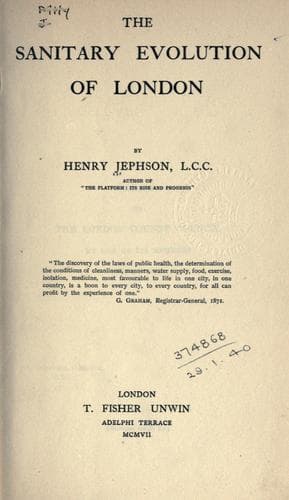
The Sanitary Evolution of LondonJephson, Henry (Henry Lorenzo)
History
The Sanitary Evolution of London
Jephson, Henry (Henry Lorenzo)
Public health -- England -- London
The returns collected by successive Census Commissioners gave
considerable information upon this point.
"London is the metropolis of the Empire," wrote the Commissioners
of 1861, "and thither the representatives of other nations, of the
Colonies, and of Scotland and Ireland resort; but it is chiefly the
field in which the populations of the several counties of England find
scope for their talents and their industry."
The majority of the inhabitants of London in 1861 were indigenous, for
1,701,177 were born within its limits; 1,062,812 were born elsewhere.
Of these 1,062,812, close on 36,000 were born in Scotland, 107,000
in Ireland, 19,000 in the Colonies, and 48,000 were foreigners.
The remainder--amounting to about 893,000--were born in the
extra-metropolitan counties of England and Wales.
"Proximity to the metropolis, and the absence of manufactures at home,
first drew the natives of these counties to London. The stream of
immigrants from the south-western counties was large: Cornwall, Devon,
Dorset, Somerset, and Wiltshire having sent 128,422 of their natives to
be enumerated in London."
Likewise the stream from Norfolk and Suffolk was large. But the great
bulk of the immigrants came from the counties immediately around London.
To put the figures in simple form--of every 1,000 inhabitants of
London, 606 were born in London, the remaining 394 were born elsewhere.
And the census provided also the means for ascertaining as correct a
death-rate as could be arrived at. In 1851 the death-rate was 23·38 per
1,000; in 1861 it was 23·18--not much of a decrease, but satisfactory
in showing that some of the evil powers of insanitation were stayed.
It is, however, always to be borne in mind that either the death-rate,
or the number of deaths, gives but an imperfect and incomplete picture
of the sanitary condition of a population. It tells but the tale of
those who have died of disease--it leaves uncounted and untold the
far greater number of those who have been either temporarily disabled
or maimed for life by disease. Estimates vary considerably as to
the number of persons who suffer from disease and recover; and the
proportion of recoveries to deaths varies in different diseases, some
diseases being so much more deadly than others. But the sick-rate
is always, and under all circumstances, very much greater than the
death-rate.
The mere taking of a census could have no visible or actual effect;
the routine of life and the action of the various economic and social
forces continued unchanged; but the information gained was of the
utmost value.
The figures and the facts recorded afforded startling demonstration of
the immensity of London, and of the growing gravity and complexity of
the great problems of London life.
Public-domain text, read in full here on John Shaqi.
Reviews
Reviews
No reviews yet
Be the first to share your thoughts on this work.
Elsewhere in the archive
Join the Discussion
Join the discussion
Sign in to leave a comment or review.
Sign InorCreate an account