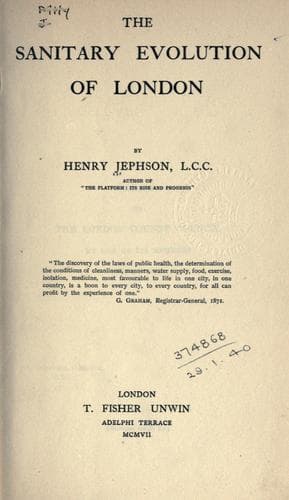
The Sanitary Evolution of LondonJephson, Henry (Henry Lorenzo)
History
The Sanitary Evolution of London
Jephson, Henry (Henry Lorenzo)
Public health -- England -- London
Their completion enabled the Metropolitan Board to fill in the open
sewers, which had so long polluted the atmosphere, and been such a
fertile source of disease in the districts where they existed, and
took away from the Vestries any excuse for delay in carrying out the
construction and putting in order of the local sewers for which they
were responsible.
The central authority had thus brought into existence a gigantic system
of sewerage by which the river near London ceased to be the main sewer
of London, and the whole of the metropolis was relieved of many of the
most powerful causes of fever, cholera, and other destructive diseases.
It was a great work, admirably and expeditiously carried out, and
it cleared the way for other sanitary reforms which were impossible
without an effective general system of sewerage, yet which were
essential if a satisfactory condition of the public health were ever to
be attained.
The central body also proved its great utility by securing uniformity
in the sewerage and drainage works which fell to the duty of the local
authorities to carry out. All plans by the Vestries had to be submitted
to the Board so that the Board might see that they were consistent with
the main system.
Both main drainage and house drainage were thus steadily being extended
and improved, but in many places things were still outrageously bad.
Nor had the creation of fresh evils been effectually prevented, for
from Bromley came the complaint that several new estates were rapidly
being covered with small house property which drained into cesspools.
And the Medical Officer of Health for Fulham wrote (1866):--
"The active operations of your Board have fortunately relieved the
Fulham district to a large extent from that pregnant source of
mischief--want of drainage; still there are large tracts of building
land yet unprovided for, on much of which houses by dozens are being
squatted without any regard to this great essential by the builders,
save the horrid cesspool system. It is enough to have to counteract
the evils of past imprudence without perpetuating them by such wilful
recklessness...."
The supply of water to the inhabitants of London was of equal
importance to an efficient system of sewerage. The problem had by no
means been solved by "The Metropolis Water Act" of 1852, which had
enacted that within five years after the passing of the Act a constant
supply should be given by the companies. Unfortunately, the supply was
in the hands of various public companies over which the local governing
authorities had practically little or no control, and, like all
sanitary legislation of this period, the results were not commensurate
with the intentions of the Legislature.
An illustration of how insufficient the supply was, was detailed in a
report of the Medical Officer of Health for Whitechapel in 1862:--
"A return has been made by the Inspector of 133 courts in the district.
Public-domain text, read in full here on John Shaqi.
Reviews
Reviews
No reviews yet
Be the first to share your thoughts on this work.
Elsewhere in the archive
Join the Discussion
Join the discussion
Sign in to leave a comment or review.
Sign InorCreate an account