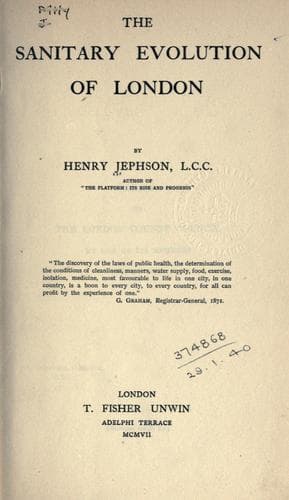
The Sanitary Evolution of LondonJephson, Henry (Henry Lorenzo)
History
The Sanitary Evolution of London
Jephson, Henry (Henry Lorenzo)
Public health -- England -- London
"Of these--in 48 which contain 388 houses and have a population of
3,233 persons the water supply is by stand taps only, from which the
water flows daily (Sundays excepted) for a period varying from quarter
to half an hour.
"This intermittent supply is totally inadequate to the wants of the
people."
Parliament made an effort in 1862[81] to amend the law, and enacted
that where a house was without a proper supply of water the owner or
occupier might be required by the Vestry to obtain such supply, and if
such notice was not complied with, the Vestry might do the necessary
work and recover the expenses from the owner, and then require the
water companies to supply the water.
But the Act was of little practical value, and was made of less value
by the inaction of the local authorities.
A few extracts from reports of Medical Officers of Health show how
thoroughly unsatisfactory and disastrous to the health of the people
the existing condition of affairs was.
The Medical Officer of Health for Fulham wrote in 1864:--
"The powers at present given by Statutes for enforcing a supply of
water for domestic use are, within the Fulham district, all but
inoperative. The cry amongst the cottagers is still for water--water
without which all other sanitary appliances are at best abortive,
without which in ample and continuous flow no community can be
preserved in healthfulness. On this essential will depend the perfect
working of our deep and costly sewers, on this alone will hang success
in minor drainage matters. Water, that first and most important element
of health and cleanliness, exists in name alone in masses of our
cottage property here, and consequently neither purity of person nor of
dwelling can be ensured."
The Medical Officer of Health for St. Martin-in-the-Fields wrote in
1864 deploring that the new laws of the water companies did not provide
for water being supplied on Sunday. "It is to be lamented that people
should at any time have to go about begging water, and more especially
so on Sundays, the very day they most require it."
And the Medical Officer of Health for Westminster wrote (1864):--
"The water supply to many of the courts and alleys is very
unsatisfactory. No Sunday supply.
"It does seem a monstrous arrangement that for 52 days in the year the
public should be deprived of that which they pay for, but have no means
of substituting by anything else."
And to complete the hardships which the people suffered under in the
matter of water supply, if the house-owner did not pay the water rates
when called upon to do so, the water company might cut off the supply
of the people in the house. This was frequently done, and the Medical
Officer of Health for Whitechapel recorded how for four months--
"The inhabitants of Tuson's Court, Spitalfields, had been entirely
deprived of water in consequence of the water company refusing to
continue any longer the supply, as the landlord had not paid the water
rate."
Public-domain text, read in full here on John Shaqi.
Reviews
Reviews
No reviews yet
Be the first to share your thoughts on this work.
Elsewhere in the archive
Join the Discussion
Join the discussion
Sign in to leave a comment or review.
Sign InorCreate an account