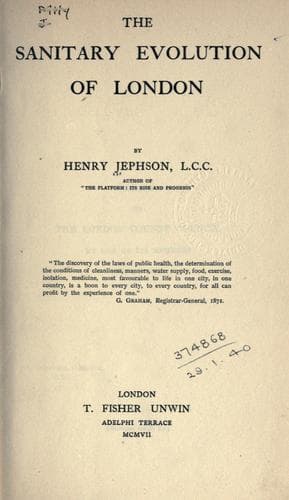
The Sanitary Evolution of LondonJephson, Henry (Henry Lorenzo)
History
The Sanitary Evolution of London
Jephson, Henry (Henry Lorenzo)
Public health -- England -- London
The quality of the water, though improved by the change of intakes to
the part of the Thames above Teddington Lock, left very much to be
desired. It was no longer contaminated by the entire sewage of the
metropolis, but it was still by sewage poured into the river and its
tributaries by towns higher up--Oxford, Reading, Windsor, Chertsey,
Hampton, and others--and received, unchecked, the whole of the
pollution, solid and fluid, of the district constituting the watershed.
And this same water, after it had been so polluted, was abstracted from
the river, sand-filtered, and pumped into the metropolis for domestic
uses and distributed to the consumers.[82]
The housing of the people was the problem which, above all others,
was more and more forcing itself upon the attention of those whose
work brought them into actual contact with the conditions of life of
the great mass of the people who were in their charge; not merely the
construction of the houses or their situation, but the accommodation
afforded and the conditions of life therein.
"Our forefathers," wrote one of the Medical Officers of Health, "knew
nothing about the public health, and cared less. They added house to
house, and street to street, according to their own will and apparent
benefit, and so have left us this mingled heritage."
And there were streets and courts and alleys which were not fit for
human habitation, and which could never be made so; and thousands upon
thousands of houses where "nothing short of a hurricane would suffice
to displace and renew the air."
London had enough to suffer under from the state of the existing
houses, and an appalling task before her to remedy them, but not alone
was this enormous evil practically unattacked, but fresh sources of
evil were allowed to be created, and new houses were being erected
which would carry into the future the evils which efforts were now
being made to put an end to.
"A house may be built anywhere," wrote one of the Medical Officers of
Health in 1862, "and almost anyhow, provided all the rooms can be
lighted and ventilated from a street or alley adjoining. The object
of the builder is to save as much ground, materials, and expense as
possible. The result is not difficult to foresee...."
No regard, moreover, was had to the ground on which new houses were
being built, though that was all-important for a healthy dwelling.
"... Some of the new houses are built upon garden mould or old 'slop
shoots,'" wrote the Medical Officer of Health for Paddington in 1870-1;
"these thin and flimsy shells of lath and plaster truly merit the term
'slop buildings.' A dangerous moisture and miasma arises from houses
built upon such an unhealthy foundation."
How disastrous the results were to the inhabitants is pointed out by
several Medical Officers of Health.
The Medical Officer of Health for Mile-End-Old-Town wrote (1866):--
Public-domain text, read in full here on John Shaqi.
Reviews
Reviews
No reviews yet
Be the first to share your thoughts on this work.
Elsewhere in the archive
Join the Discussion
Join the discussion
Sign in to leave a comment or review.
Sign InorCreate an account