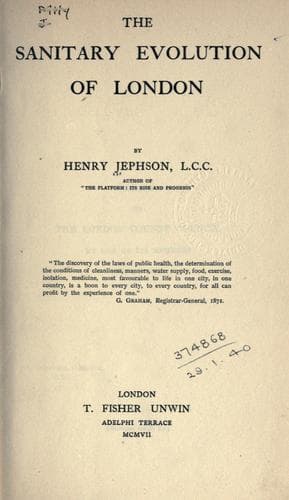
The Sanitary Evolution of LondonJephson, Henry (Henry Lorenzo)
History
The Sanitary Evolution of London
Jephson, Henry (Henry Lorenzo)
Public health -- England -- London
"Rents have become so heavy that few labouring men can afford more than
one room. Overcrowding in such rooms must increase, and with it the
fearful results of men, women, girls, and boys, all sleeping in the
same apartment. Neither religion nor morality can increase under the
existing circumstances of our poorer classes. It is almost returning
to the habits of our barbarous ancestors or the untutored savages of
Africa and Australia."
And the Medical Officer of Health for Holborn wrote:--
"Depend upon it, the moral and physical training of the people is
more influenced by lessons--whether in health and cleanliness, or in
religion and morality--that they are constantly receiving at their own
firesides than by any extraneous teachings.
"When a child has been allowed to grow up with a diseased body, and a
polluted mind, in a wretched room, without light, without cleanliness,
and without any notions of decency, our curative efforts, whether
medical, missionary, or reformatory, are as mere patchwork compared
with the great preventive precaution of keeping his home as pure, as
decent, and as wholesome, as possible."
No more powerful description can be given of the moral evils of
overcrowding than that of Dr. J. Simon in 1865:--
"Where 'overcrowding' exists in its sanitary sense, almost always it
exists even more perniciously in certain moral senses. In its higher
degrees it almost necessarily involves such negation of all delicacy,
such unclean confusion of bodies and bodily functions, such mutual
exposure of animal and sexual nakedness, as is rather bestial than
human.
"To be subject to these influences is a degradation which must become
deeper and deeper for those on whom it continues to work. To children
who are born under its curse, it must often be a very baptism into
infamy."[85]
Overcrowding was not confined to tenement-house rooms alone. The great
bulk of the working classes left their overcrowded abodes to do their
day's work in overcrowded factories, workshops, and workplaces; and
in very many such places men, women, and even children were crammed
together in rooms where healthy existence was impossible.
A great deal of information on this great branch of the sanitary
condition of the inhabitants of London is given in the Reports from
the Commissioners on Children's Employment, and in the very valuable
reports of special inquiries instituted by the Medical Department of
the Privy Council.
One of these inquiries related to Bakehouses, of which there were about
3,000 in the metropolis in 1862.[86]
As a rule the place in which the bread of London was made was what in
houses in general was the coal-hole and the front kitchen.
Very many bakehouses in London were stated to be in a shockingly
filthy state, arising from imperfect sewerage and bad ventilation and
neglect, and the bread must, during the process of fermentation, get
impregnated with the noxious gases.
Public-domain text, read in full here on John Shaqi.
Reviews
Reviews
No reviews yet
Be the first to share your thoughts on this work.
Elsewhere in the archive
Join the Discussion
Join the discussion
Sign in to leave a comment or review.
Sign InorCreate an account