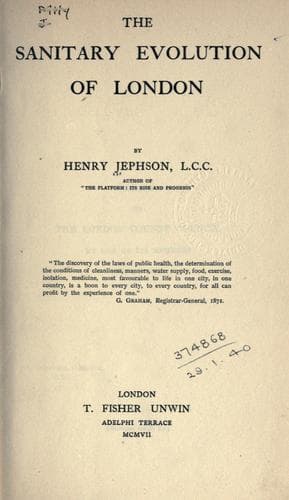
The Sanitary Evolution of LondonJephson, Henry (Henry Lorenzo)
History
The Sanitary Evolution of London
Jephson, Henry (Henry Lorenzo)
Public health -- England -- London
The sleeping places were of the worst description,[87] some of the
men sleeping in the bakehouse itself. Many bakehouses were infested
with rats, beetles, cockroaches, and noxious smells. The smells from
the drains were very offensive--the air of the small bakehouses was
generally overloaded with foul gases from the drains, from the ovens,
and from the fermentations of the bread, and with the emanations
from the men's bodies; the air thus contaminated was necessarily
incorporated with the dough in the process of kneading.
Half of the bakehouses in London would, it was stated, require the
application to them of the Nuisances Removal Act.
Another inquiry related to the tailoring trade in the metropolis.[88]
The places in which work was done were reported as varying much in
their sanitary conditions, but almost universally were overcrowded and
ill-ventilated, and in a high degree unfavourable to health. Some were
underground, either in the basement of a house, or built like a large
kennel in a small enclosed yard, and were such that no domestic servant
would inhabit. In exceedingly few shops had there been any attempts
at ventilation. The ventilation through the windows was practically
inefficient, and instances were given of what had been found in sixteen
of the most important West-end shops. In one an average of 156 cubic
feet space was allowed to each operative, in another 150 cubic feet, in
another 112 cubic feet. Deficient ventilation, heat, and draughts, were
the causes of diseases.
A paper read by Dr. E. Symes Thompson (Assistant Physician to King's
College Hospital) at the Social Science Association Meeting in London,
1862, described the condition under which printers did their work.
"Printers often work sixteen to eighteen hours a day in a confined and
heated atmosphere; perhaps thirty men and as many gaslights in a low
room without ventilation or chimney, where air only enters when the
door is opened....
"Printing is only one of the many trades which entail the sacrifice of
every hygienic necessity, and the cause of the unhealthy looks of the
workpeople cannot fail to strike any observant person who may visit
their workshops. The rooms are mostly low, the windows fixed, and there
is often no chimney or other ventilation.
"This is the case in large and small factories as well as in
workshops--in the workroom of the milliner, the sempstress, or the
bookbinder.
"In many occupations, besides the evils alluded to, the air is
charged with foreign matters, which are drawn into the lungs at each
inspiration; _e.g._, the sorting and tearing up of dirty rags in
paper manufactories. The dust and fluff arising in flax, woollen, and
cotton factories, and in furworks, produce similar results--and brass
finishers."
And in another paper at the same meeting Mr. George Godwin detailed
his experiences as regarded the conditions under which milliners,
dressmakers, and other needlewomen worked.
Public-domain text, read in full here on John Shaqi.
Reviews
Reviews
No reviews yet
Be the first to share your thoughts on this work.
Elsewhere in the archive
Join the Discussion
Join the discussion
Sign in to leave a comment or review.
Sign InorCreate an account