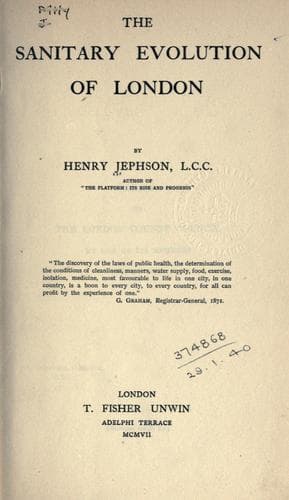
The Sanitary Evolution of LondonJephson, Henry (Henry Lorenzo)
History
The Sanitary Evolution of London
Jephson, Henry (Henry Lorenzo)
Public health -- England -- London
"In an upper room in Oxford Street, not 10 feet square, I have seen a
dozen delicate young women closely shut up making artificial flowers;
and there when business is pressing they work from 8 in the morning
till 12 o'clock at night.
"Many of the workrooms of fashionable milliners are similarly
overcrowded, as are those where young girls are engaged in
book-stitching."
He gave as an example a house in Fleet Street.
"The staircase is confined and without ventilation--the atmosphere is
steaming and smells of glue.
"In the first room looked into, 40 young women and girls were sorting
and stitching books. There was a stove but no ventilation.... There
were more than 200 persons in that house, pent up without provision of
the first necessity of life--pure air. Poor creatures so placed are
being slowly slain.
"Other trades, such as cap and bonnet makers, trimmers, blond-joiners,
&c., to which I have looked with some little care, are forced in many
places to do just the same thing."
"The extent of suffering entailed, and the loss to the community, it
would be difficult to calculate. It is time that legislation should
be tried to secure wholesome workplaces for the people. Interference
is needed for thousands of persons--especially young females--the
debilitated mothers _in posse_, should they live, of our future
population. In our infant schools, too, where incalculable mischief is
done by overcrowding, it is greatly required. The evil is sapping the
strength of the land."
"In several parts of London persons employed in making cheap clothing
are boxed up in crowds, ... some striving to get a living in a
death-giving atmosphere.
"Shoemakers are often as ill-placed. In wretched apartments, in an
ill-drained house, may be found men and boys huddled together without
room to breathe."
It was under such pitiable conditions that large masses of the working
classes of London had to earn their daily bread.
Lord Shaftesbury truly said that "the sanitary condition of these
people was of national importance, not only on account of the waste of
life, but the waste of health which every year threw thousands and tens
of thousands upon the rates."[89]
And large numbers of children were also employed under insanitary
conditions, and were made to do heavy work for long hours, and
the consequences to their health were disastrous.[90] That their
constitutions should be undermined and their physical development
should be most seriously deteriorated was a necessary result.
There was a chorus from the Medical Officers of Health as to the evil
sanitary consequences of overcrowding.
"Overcrowded dwellings are among the most prolific sources of disease,
immorality, and pauperism."[91]
"Overcrowding--one of the elements by which disease is not only
generated but sustained."[92]
"Overcrowding is a constant source of fever."
Public-domain text, read in full here on John Shaqi.
Reviews
Reviews
No reviews yet
Be the first to share your thoughts on this work.
Elsewhere in the archive
Join the Discussion
Join the discussion
Sign in to leave a comment or review.
Sign InorCreate an account