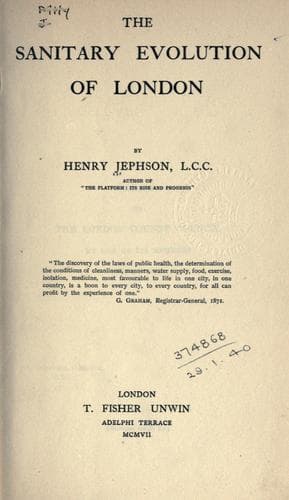
The Sanitary Evolution of LondonJephson, Henry (Henry Lorenzo)
History
The Sanitary Evolution of London
Jephson, Henry (Henry Lorenzo)
Public health -- England -- London
"If it were not for the vigilance of the Inspectors in visiting the
houses of the poor, nuisances would remain altogether unattended to;
for very few of the poor dare to make a complaint from fear of being
compelled to quit their tenements."
The Medical Officers of Health recognised that much of the bad
condition of the dwellings of the poorer classes was due to the people
themselves.
Thus the Medical Officer of Health for Westminster wrote (1865-6):--
"It is much to be regretted that in certain districts of the parish
only a temporary good is effected by a sometimes lavish expenditure on
the part of the proprietor. The habits of the people are such that it
is almost impossible to do anything for their benefit. Not only are
they filthy in themselves, but they take every opportunity to break,
destroy, and steal anything that may be of value, and what is even
worse they appear to negative any sanitary precaution effected for
their benefit."
But the broad truth was that the real, the primary responsibility
rested upon the "owners."
Theirs was the property. And them it behoved to keep that property in a
condition which was not a danger to the community and to the State.
The Medical Officer of Health for Whitechapel wrote (1865):--
"The duty and interests of landlords appear to be at variance as
regards their doing to their houses what is absolutely necessary for
the well-being of their tenants. It is unquestionably the duty of
landlords to keep the houses which they let out in separate tenements
to the poor in a healthy condition; but this is not always done even if
compulsory orders are signed and summonses issued....
"Many of the landlords of small house property fully understand and
carry out the rights of ownership, but fail to carry out the duties
which are enjoined upon them as owners."
The Medical Officer of Health for Islington, referring to some vile
property in his parish, wrote (1863):--
"Landlords of such property as this will rarely do anything out of
consideration for the health or lives of their tenants; compulsion
alone will extort amendments. What is needed here is the closure of the
fatal houses until made fit for human habitation."
How an "owner" could manage his property can be gathered from the
following report of the Medical Officer of Health for Paddington
(1863), which called attention to "the insanitary condition of a
block of houses (about thirty in number) which had been for many
years notoriously liable to the invasion of epidemics and to the
prevalence of those diseases which are the known product of sanitary
neglect--badly constructed and dilapidated, and wanting in the
commonest appliances of cleanliness. All were the property of one
individual who had been repeatedly urged to put them in a proper
sanitary state."
But it was not until stringent compulsory measures were taken that he
began to do so, and some years elapsed before they were really done.
Public-domain text, read in full here on John Shaqi.
Reviews
Reviews
No reviews yet
Be the first to share your thoughts on this work.
Elsewhere in the archive
Join the Discussion
Join the discussion
Sign in to leave a comment or review.
Sign InorCreate an account