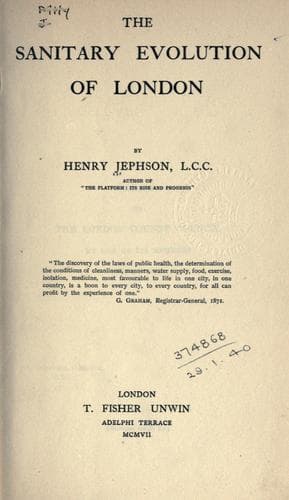
The Sanitary Evolution of LondonJephson, Henry (Henry Lorenzo)
History
The Sanitary Evolution of London
Jephson, Henry (Henry Lorenzo)
Public health -- England -- London
Here is another dreadful case of overcrowding and insanitation--this
time in St. Marylebone (1868).
Edwards Place:--
"Ten six-roomed houses occupied by 84 families, 277 persons, houses
very dilapidated, many unfit for human habitation. Orders for sanitary
work are continually being sent out by the Vestry to the owner of this
wretched property.
"A rental of £10 per annum would be an extravagant sum to pay for
either of these miserable dwellings, yet more than three times that sum
is expected from the destitute and indigent people who inhabit them."
Read by the light of the knowledge that insanitary property meant
disease, and disablement, and death to a very high percentage of its
occupiers, the proper compulsion to have applied to "owners" such as
these would have been proceedings before a Coroner's jury for culpable
homicide if not for actually deliberate murder.
The community has a right to be protected from the evil results of the
miserable housing of the poor.
Mr. George Godwin said in 1862, at the meeting of the National
Association for Promoting Social Science:--
"It should be no answer to the requirement of a certain cubical space
for each occupier, that the financial resources of the parties will not
admit of it.
"A man is not permitted to poison with prussic acid those who are
dependent on him because he is poor; neither should he be allowed on
that ground to kill them with bad air and set up a fever-still for the
benefit of his neighbours."
Parliament, under the pressure of a slowly-developing public opinion,
and in view of the ever accumulating evidence and proof of the almost
incredible insanitary condition in which great masses of the people of
London were living, was beginning to show less reluctance to discuss
and deal with some of the multifarious matters affecting the public
health.
In 1860 it passed an Act which, however well intentioned, was not of
much effect. It was an effort to secure more wholesome articles of food
and drink for the public by preventing their adulteration.
The past history of such legislation was rather interesting.[98] In
1731 an Act has been passed prescribing a penalty for "sophisticating
tea."
"Several ill-disposed people frequently dyeing, fabricating, very large
quantities of sloe-leaves, &c., in imitation of tea, and colouring or
staining and dyeing such leaves, and vending the same as real tea to
the prejudice of the health of His Majesty's subjects."
"In year 1766-7 a further Act was passed inasmuch as 'such evil
practices were increased to a very great degree to the injury and
destruction of great quantities of timber, wood, and underwoods.'
"Coffee had also been the subject of legislation, 'burnt scorched, or
roasted peas, beans, &c.,' being used to adulterate it.
"In 1816 an Act was passed against the adulteration of beer and porter,
and the use of molasses, liquorice, vitriol, quassia, guinea pepper, or
opium, and a lot of other ingredients being prohibited."
Public-domain text, read in full here on John Shaqi.
Reviews
Reviews
No reviews yet
Be the first to share your thoughts on this work.
Elsewhere in the archive
Join the Discussion
Join the discussion
Sign in to leave a comment or review.
Sign InorCreate an account