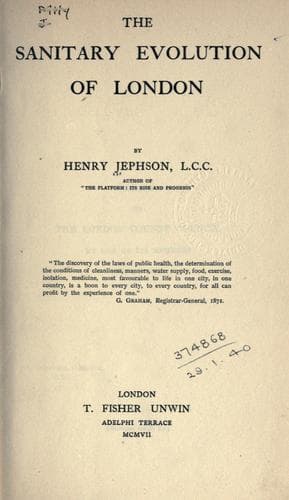
The Sanitary Evolution of LondonJephson, Henry (Henry Lorenzo)
History
The Sanitary Evolution of London
Jephson, Henry (Henry Lorenzo)
Public health -- England -- London
"They appointed an examiner under the Adulteration of Foods Act
(1860), and also under the Metropolitan Gas Act (1860), but the person
appointed had no tools given him with which to perform the work
entrusted to him.
"Both the Acts are dead letters in the parish. As to the Metropolitan
Gas Act, it conferred a large benefit, both as to purity and cost, on
the metropolis, but the Vestries failed to carry out a single effective
or important provision of that Act."
In 1860, also, an Act had been passed empowering the local authorities
in the metropolis to provide vehicles for carrying persons suffering
from infectious diseases to hospital, and so obviating the danger to
the public of such persons being conveyed in cabs or other public
vehicles. That Act was also inoperative.
The Vestries and District Boards, however, did perform a considerable
amount of useful work. Local sewerage and drainage works were on the
whole effectively dealt with. The rest of the work done was mostly of
the routine order, such as scavenging and paving and lighting, though
even that was not always done in the most sensible way, as exemplified
in Paddington (1866).
"The street sweepings of mud collected by the scavengers are stored in
enormous quantities in the middle of the parish in a closely inhabited
neighbourhood. Here it is allowed to decompose, &c. If it were intended
to contrive an arrangement for developing malaria in the midst of a
town population nothing could be better adapted for the purpose."
A few of them had soared to the height of widening a street, or
acquiring some small open space; in most, if not all, of these cases
receiving financial help from the central authority.
But as to the main causes of the prevailing insanitary evils, their
aversion to active measures was constantly in evidence; equally so
where the enforcement of the law would have entailed cost on the owners
of insanitary houses.
In some matters the plea of defects in the legislation might have been
justifiably urged by them; in others they were often much hampered by
the dilatory procedure attending proceedings for enforcing the sanitary
provisions of the Metropolitan London Management Act.
One of the Medical Officers of Health gives an illustration:--
"A very great nuisance was reported to us. We visited it, but had to
wait a fortnight before the Vestry met in order to get leave to apply
for a summons. The magistrate requires a week before hearing the case,
and then he gives a week or two to do the work. So for a month or five
weeks the nuisance may remain."
The result was that infectious disease was given a long opportunity to
spread itself unchecked through a whole district; an opportunity which
it freely availed itself of.
Public-domain text, read in full here on John Shaqi.
Reviews
Reviews
No reviews yet
Be the first to share your thoughts on this work.
Elsewhere in the archive
Join the Discussion
Join the discussion
Sign in to leave a comment or review.
Sign InorCreate an account