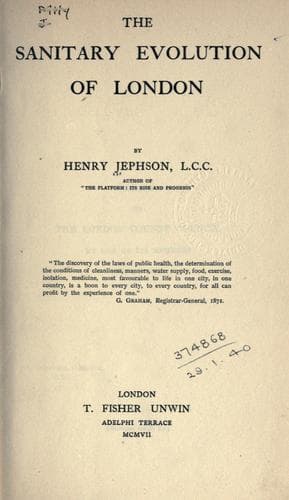
The Sanitary Evolution of LondonJephson, Henry (Henry Lorenzo)
History
The Sanitary Evolution of London
Jephson, Henry (Henry Lorenzo)
Public health -- England -- London
"In 1836 an Act was passed against the adulteration of bread."
And now in 1860 it was enacted that "every person who shall sell as
pure or unadulterated any article of food or drink which is adulterated
or not pure," should on conviction be fined.
The Vestries in the metropolis were empowered to appoint analysts. The
appointment was voluntary on the part of the local authorities, and,
if analysts were appointed, their duties were confined to receiving
and analysing articles submitted to them by the purchasers, and
certifying the results. The purchasers had to pay the cost. No officer
was appointed to obtain samples or to enforce the Act. And the Act is
therefore worthy of note more as an illustration of the inaction of the
local authorities than for any effect it had as regarded the prevention
of adulteration.
In 1863 Parliament passed the "Bakehouse Regulation Act,"[99] which
enacted that every bakehouse should be kept in a cleanly state, should
be frequently lime-washed, and should be properly provided with proper
means for effectual ventilation, and be free from effluvia arising from
any drain, privy, or other nuisance.
Also its use as a sleeping-place was prohibited, and the onus of
enforcing the provisions of the Act was imposed upon the local sanitary
authority.
And in 1863 it declared[100] that the law made in 1855 as to the
inspection and seizure of unwholesome food--meat, poultry, flesh, fish,
vegetables, fruit, &c., &c.--was defective, and that other and more
effectual provisions should be substituted therefor; and others were
accordingly substituted.
By an Act in 1864 the main principles contained in previous Factory
Acts were carried a stage further, in some instances even to trades
carried on in private houses.
"Every factory to which this Act applies shall be kept in a cleanly
state and be ventilated in such a manner, &c., as to render harmless
dust, &c."
Unfortunately the main breakdown in the metropolis in regard to nearly
all the ameliorative sanitary legislation of Parliament was directly
caused by the very local authorities who had been specially created
for the purpose of administering those laws. Primarily they were
responsible for the failure of very much of that legislation, and they
never seem to have at all realised, or been impressed by, the gravity
of their trust, or by the great responsibility to their fellow-citizens
which their position entailed.
Even in comparatively small matters their ingenuity in counteracting
the intentions of the Legislature was remarkable, as can be seen from
the following passage in a report of one of the Medical Officers of
Health:--
"I refer specially to the Sanitary Acts, to the Adulteration of Food
Act, and to the Metropolitan Gas Act, in each of which cases the powers
entrusted to them have not been carried out.
Public-domain text, read in full here on John Shaqi.
Reviews
Reviews
No reviews yet
Be the first to share your thoughts on this work.
Elsewhere in the archive
Join the Discussion
Join the discussion
Sign in to leave a comment or review.
Sign InorCreate an account