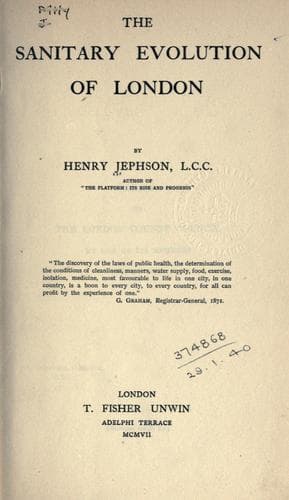
The Sanitary Evolution of LondonJephson, Henry (Henry Lorenzo)
History
The Sanitary Evolution of London
Jephson, Henry (Henry Lorenzo)
Public health -- England -- London
He attributed the failure of the Vestries to the inferior calibre of
the persons composing them--"they agree to resolutions, but do not
carry them out. The ratepayers take no interest in the elections in our
parish. There is a large number of the owners of small house property
in the Vestries who regard with great disfavour any increase of the
rates, however beneficial the increase might be to the general health
of the district."
But some witnesses went further. Dr. William Rendell, who had been
Medical Officer of Health for St. George-the-Martyr, said:--
"I believe, the law being new to the Vestry, they did not quite
understand the mode of carrying it out; but it was partly from corrupt
motives, for on one occasion one of the principal members of the
Vestry, an owner of considerable property in the parish, called me
aside and requested me to pass over certain property of his that I
found in an extremely bad condition. I did not pass it over, of course.
The chairman of the local committee was, as I thought, appointed as a
positive obstructer of sanitary measures; at all events he acted as
such. The obstructions arose from an unwillingness to incur expense for
fear of increasing the rates, and from an interest that the members of
the Vestry had in keeping up the present state of things."
Jobbery, and the exercise of influence to obstruct and defeat the law,
are hard to prove, especially after the lapse of years, but one fact
which stands out conspicuous, and which is incontestable, shows how
reprehensibly the great majority of the Vestries and District Boards
failed to administer laws which in the interests of the public health,
and therefore of the public welfare, it was their duty to administer.
Deliberately, and in the light of knowledge, they would not make
adequate arrangements even for the sanitary inspection of their
respective districts.
Thus, in Bethnal Green, in 1861, there was a population of 105,000
persons, and 14,731 houses. The Vestry appointed one single Inspector
of Nuisances to cope with the insanitary conditions of this city of
houses, and of this mass of people. Shoreditch, with a population of
129,364 persons, and 17,072 houses, also one Inspector. St. George's,
Hanover Square, with 88,100 persons and 10,437 houses, one Inspector;
Paddington, Bermondsey, and several others, all with large populations
and thousands of houses, one Inspector each.[103]
A few had appointed two Inspectors: St. Marylebone with 161,680 persons
and 16,357 houses, and Islington with 155,341 persons and 20,704 houses.
Kensington, Lambeth, and Limehouse, had appointed three Inspectors
each. St. Pancras headed the list with four, but its population was
close upon 200,000 living in close upon 22,000 houses.
Public-domain text, read in full here on John Shaqi.
Reviews
Reviews
No reviews yet
Be the first to share your thoughts on this work.
Elsewhere in the archive
Join the Discussion
Join the discussion
Sign in to leave a comment or review.
Sign InorCreate an account