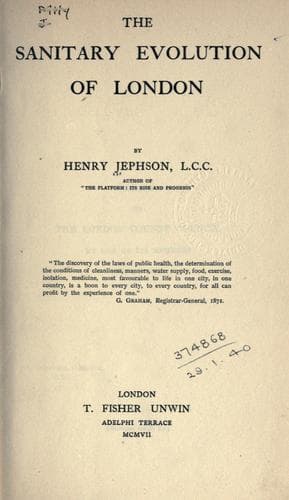
The Sanitary Evolution of LondonJephson, Henry (Henry Lorenzo)
History
The Sanitary Evolution of London
Jephson, Henry (Henry Lorenzo)
Public health -- England -- London
How could it be expected that one Inspector could within a year
possibly inspect even one tithe of the places which it was his duty to
inspect apart altogether from other duties he ought to perform? The
Vestries and District Boards had the facts constantly before their
eyes (in the returns of work made to them by the Medical Officer of
Health)--the numerous insanitary houses unfit for human habitation,
the overcrowding, the terrible amount of sickness and misery, and
they could calculate from the one man's work, the number of houses in
the parish which were in a condition dangerous to the health of their
inmates, and to the public health generally. The salary of an Inspector
was so paltry that they had no excuse on the ground of economy; and
the conclusion is inevitable that either they did not care what the
sanitary condition of the people was, or that "vested interests in
filth and dirt" were so powerful on those bodies that filth and dirt
must not be interfered with at the expense of "owners" upon whom the
cost of improvement must fall.
And a grimmer light is thrown upon these figures by the following
statement of the Medical Officer of Health for Lambeth made in 1889,
but referring to 1869.
"The Sanitary Inspector of twenty years ago (that is to say of 1869)
was an unskilled workman, holding that which might almost be regarded
as a sinecure office; an official recruited into the services of the
Vestry from the rank of ex-sailors, ex-policemen, or army pensioners.
A knowledge upon sanitary matters acquired from a course of technical
training was not expected from him."
The treatment meted out to some of the Medical Officers of Health
also showed the hostility of the Vestries to action. Numerous are the
passages in their reports complaining of their recommendations being
ignored. These officers were miserably paid, allowing even for their
being able to take private practice. The Medical Officer of Health for
Lambeth was stated to have been the worst paid--receiving only £200 a
year for the performance of duties attaching to an area of 4,000 acres
with 23,000 inhabited houses upon it, inhabited by 162,000 persons.
Dr. W. Farr (of the Registrar General's Office) said:--
"I believe that in certain districts in London the Medical Officer of
Health is under all sorts of restraints. If he is active, they look
upon him with disfavour, and he is in great danger of dismissal."[104]
The Vestry of St. James', Westminster (1866), checked the zeal of
their Medical Officer, Dr. Lankester, whose salary was £200 a year, by
reducing it to £150 after a year or two when they found he was very
earnest in his work.
Dr. Rendell, the Medical Officer of Health for St. George-the-Martyr,
Southwark, resigned "in disgust that he was not allowed to carry out
the duties of his office."
Once more the approach of Asiatic cholera--the nemesis of insanitation,
and of "fainéant" local authorities--created anxiety.[105]
Public-domain text, read in full here on John Shaqi.
Reviews
Reviews
No reviews yet
Be the first to share your thoughts on this work.
Elsewhere in the archive
Join the Discussion
Join the discussion
Sign in to leave a comment or review.
Sign InorCreate an account