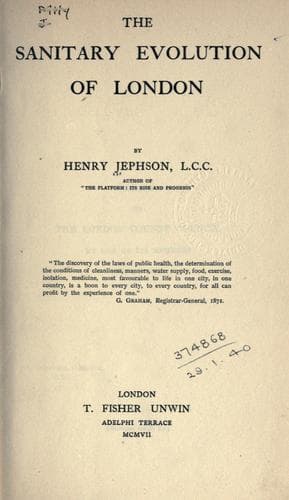
The Sanitary Evolution of LondonJephson, Henry (Henry Lorenzo)
History
The Sanitary Evolution of London
Jephson, Henry (Henry Lorenzo)
Public health -- England -- London
An effort was also made to check the spread of infectious disease
by giving the local authority considerable powers as regarded
disinfection. It was enacted that the local authority might provide
a proper place for the disinfection of clothing and bedding which
might have been rendered liable to communicate disease to others; and
the authority was empowered to maintain carriages for the conveyance
to hospital of persons suffering under any infectious or contagious
disease. A blow was struck at the iniquitous but common practice of
letting a room where there had been dangerous infectious disorder,
until it had been disinfected. And provision was made for the
establishment of a hospital for the reception of the sick.
All these were most considerable reforms, and would have been most
useful had they been given effect to and properly enforced.
The most important and wide-reaching provision of the Act was that
directed against overcrowding.
The 35th Section enacted that regulations might be made by the Sanitary
Authority (in other words, the Vestry or District Board) for fixing the
number of persons who might occupy a house, or part of a house, let in
lodgings, or occupied by members of more than one family. Houses so
let were to be registered by the Vestry. The regulations could fix a
certain number of cubic feet of air space which should be available for
each person. By this means the number of persons who might live in a
house, and in the rooms of the house, could be limited.
That was the plan--simple enough in appearance--which Parliament
devised for contending with the great evil of overcrowding.
And then, as regarded the sanitation of the houses when registered, it
enacted that regulations should contain provisions for their being put
into and kept in a clean and wholesome state. And to secure this being
done, regulations were made for their inspection.
It was an original and comprehensive scheme of reform. It struck
at the root of the two great evils--overcrowding and insanitary
dwellings; at overcrowding, by the limitation of the number of persons
inhabiting a house, or part of a house, and at insanitary dwellings by
a series of regulations enforcing the necessary measures for a decent
standard of sanitation. But it was something far more than this. It
was the declaration of principles of the utmost importance. It was a
declaration of the principle that the responsibility for the condition
of the "houses let in lodgings" should be on the shoulders of the
"owner" of the house. It was the declaration of the principle that the
"owner" should not be allowed to use his property to the detriment,
to the injury of the public. It affirmed, so far as London lodging or
tenement houses were concerned, the great principle, abhorred by so
many "owners," that "property has its duties as well as its rights."
Public-domain text, read in full here on John Shaqi.
Reviews
Reviews
No reviews yet
Be the first to share your thoughts on this work.
Elsewhere in the archive
Join the Discussion
Join the discussion
Sign in to leave a comment or review.
Sign InorCreate an account