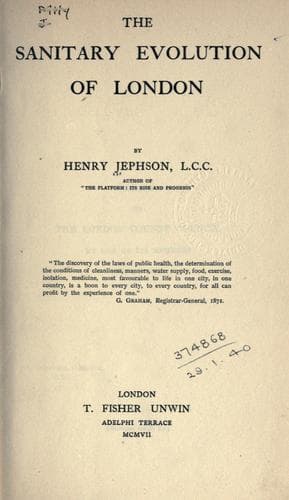
The Sanitary Evolution of LondonJephson, Henry (Henry Lorenzo)
History
The Sanitary Evolution of London
Jephson, Henry (Henry Lorenzo)
Public health -- England -- London
The Act was, however, even more remarkable for the recognition it
contained of another principle of vital importance to the people
of London--the principle of central authority over local sanitary
authorities who neglected their duties.
Hitherto the local authorities were practically their own masters,
and could with absolute impunity neglect to put the provisions of the
existing health laws into operation; and "often their inaction had been
an absolutely inexcusable neglect of duty."
A power of appeal against this inaction was given. Where complaint was
made to a Secretary of State that a nuisance authority had made default
in enforcing the provisions of the Nuisances Removal Acts, he could,
if satisfied after inquiry that the authority had been guilty of the
alleged default, make an order limiting a time for the performance
of the duty, and if the duty was not performed within that time, he
could appoint some person to perform the duty and charge the costs
to the authority. And where the local authority had made default in
instituting proceedings against some sanitary law breaker, he could
order the chief police officer to institute them. These provisions
were a recognition of the fact, long patent to even the blindest,
that local authorities did not do their duty, and of the necessity of
devising a means of securing that a necessary public duty should be
done.
The fact was emphasised a few years later by the Royal Sanitary
Commissioners, who pointed out (1871) that--
"However local the administration of affairs, a central authority will
nevertheless be always necessary in order to keep the local executive
everywhere in action."
The real underlying truth now beginning to be discerned was that in
the matter of health or disease, London could not be treated in bits,
each governed by an independent body, but must be regarded as, what it
really was, one single entity or whole.
In another way also was the principle of central authority very clearly
affirmed. The Vestries were not to have a free hand in making their
regulations under the 35th Section. Any they made had to be approved by
a Secretary of State.
This was a considerable limitation of the freedom of the Vestries,
but it secured more or less uniformity in the powers of the local
authorities in this particular matter.
But the vigorous administration by all the local authorities of the
laws passed to secure the health of the public, was even more greatly
to be desired; for, from force of circumstances, the consequences--one
way or the other--could not be confined to the sphere of action of each
local authority.
Public-domain text, read in full here on John Shaqi.
Reviews
Reviews
No reviews yet
Be the first to share your thoughts on this work.
Elsewhere in the archive
Join the Discussion
Join the discussion
Sign in to leave a comment or review.
Sign InorCreate an account