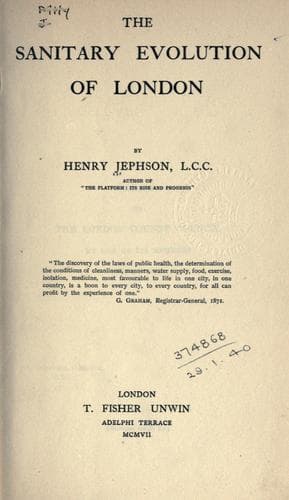
The Sanitary Evolution of LondonJephson, Henry (Henry Lorenzo)
History
The Sanitary Evolution of London
Jephson, Henry (Henry Lorenzo)
Public health -- England -- London
The lives and welfare of the inhabitants of this vast city are so
closely, so inextricably interwoven that, in matters affecting the
public health, the action or inaction of one authority may vitally
affect the health and the lives, not alone of its neighbours, but
even of the people of the city as a whole. Disease and death are no
respecters of municipal boundaries, and are not hemmed in or restrained
by lines drawn upon maps or recorded in Acts of Parliament.
This community of interest of the inhabitants of London was, however,
scarcely, if at all, recognised by the general public--it was but
seldom the motive to action by the local authorities--but some of
the Medical Officers of Health now and then referred to it in their
reports.
Thus the Medical Officer of Health for Mile-End-Old-Town pointed out
(1863) that--
"An untrapped drain, an overcrowded house, an unventilated alley, a
rotting dungheap, or a foul closet, may spread disease and sorrow in an
entire neighbourhood."
And the Medical Officer of Health for Paddington pointed out (1870-1)
that--
"The danger of harbouring a contagious disease is not confined to the
individual suffering--it is a matter that concerns the community."
And the Medical Officer of Health for Whitechapel wrote (1865):--
"Here I would remark, that a uniform system of inspection of all the
houses in the several districts in London which are let out in separate
tenements should be repeatedly and systematically adopted; for if all
the Vestries and local Boards do not act together in this important
matter, hotbeds of epidemic diseases will remain undiscovered which
will serve as centres from whence such diseases may emanate, and extend
over the entire metropolis. The whole population of London, therefore,
is interested in the prompt removal of nuisances."
Immediately on the passing of the Act some of the Vestries made efforts
to deal with overcrowding under the Section which enacted that--
"Any house so overcrowded as to be dangerous or prejudicial to the
health of the inmates" is to be considered a "nuisance."
That, however, was only a temporary remedy, and affected only
overcrowding. Section 35 went to the root of the matter when it
insisted that in addition to the prevention of overcrowding, the
house in which the people lived should be kept clean and in sanitary
condition.
"The very foundation of our sanitary structure," wrote the Medical
Officer of Health for St. George-the-Martyr, "depends upon the right
housing of the poor."
The Section 35 was promptly put in force by a few of the
Vestries--Chelsea and Hackney being the first to make Regulations and
to enforce them.
Public-domain text, read in full here on John Shaqi.
Reviews
Reviews
No reviews yet
Be the first to share your thoughts on this work.
Elsewhere in the archive
Join the Discussion
Join the discussion
Sign in to leave a comment or review.
Sign InorCreate an account