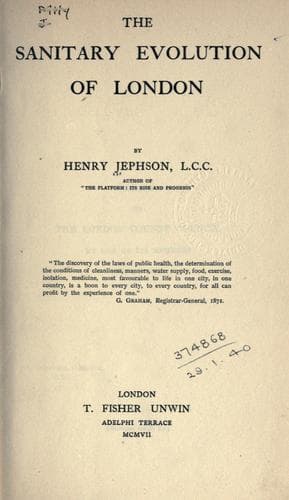
The Sanitary Evolution of LondonJephson, Henry (Henry Lorenzo)
History
The Sanitary Evolution of London
Jephson, Henry (Henry Lorenzo)
Public health -- England -- London
In Whitechapel (1867), rules and regulations were adopted by the Board.
"Unfortunately," wrote the Medical Officer of Health, the Act was
permissive, not compulsory.
"I brought under the notice of your Board several houses which in my
opinion ought to be registered.
"... The Board having reserved to itself the power of determining as to
the propriety of causing any house to be placed upon the register, this
enactment, which was framed not only for the improvement of the moral
and physical condition of the poor, but for the benefit of the whole
community, has been carried into effect in only one instance."
In Islington, draft Regulations were prepared, but it does not appear
that they were ever adopted.
In Paddington, the Vestry decided against putting the Regulations in
force.
In Westminster, "such obstacles were offered by the holders of small
property" to the Regulations that they were not enforced.
And on the south side of the river the story was very much the same.
The sting of the enactment was that it put house-owners to the
expense of putting the house into, and maintaining it in, habitable
and sanitary repair, and to the expense of annually painting or
lime-washing it; the provision of proper ventilation--of sanitary and
washing accommodation, and for a supply of water: in fact, of doing to
the houses that which was essential for the health of their occupants.
The Regulations simplified and shortened, and made more effective,
the processes for enforcing penalties for breaches of the sanitary
laws--all which was of course unpalatable to the sanitary law-breaker.
And so the great bulk of the local authorities would have nothing to do
with this 35th Section or its Regulations.
The law was not compulsory, but permissive--and they availed themselves
of that permission.
But the Vestries and District Boards who took no action, and allowed
the principal provision of the Act to be a dead letter, proved by their
conduct their deliberate determination not to impose what was a just
expense upon the "owners," even though the not doing so should result
in a frightful annual sacrifice of human life, and in an untold amount
of human suffering and misery, and a long train of physical and moral
evils of the very worst character.
That the Act had been successfully administered by some two or three
Vestries proved that it was quite a workable measure--so no excuse
could be raised on that ground by the recalcitrant Vestries.
Their attitude is an irrefutable proof of their selfish indifference to
human suffering where it clashed with the "rights of property," and of
their incapacity for the position they held as guardians and trustees
of the people.
"The slaughter-houses and cow-houses are ordered to be whited at least
twice a year, while the houses of the poor are allowed to remain for
years without this important means of purification."
Public-domain text, read in full here on John Shaqi.
Reviews
Reviews
No reviews yet
Be the first to share your thoughts on this work.
Elsewhere in the archive
Join the Discussion
Join the discussion
Sign in to leave a comment or review.
Sign InorCreate an account