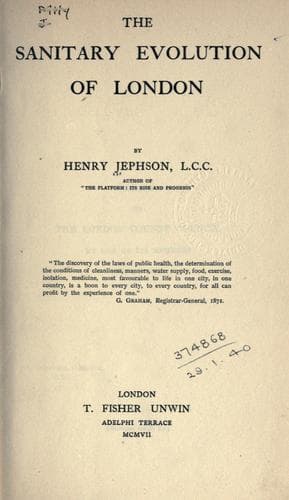
The Sanitary Evolution of LondonJephson, Henry (Henry Lorenzo)
History
The Sanitary Evolution of London
Jephson, Henry (Henry Lorenzo)
Public health -- England -- London
The problem of overcrowding was, undoubtedly, a most difficult one--and
some of the Medical Officers of Health were realising how difficult it
was to treat with any hope of success.
Thus the Medical Officer of Health for Bethnal Green set forth the
state of his parish in 1867:--
"The population of Bethnal Green has now nearly reached 120,000, and
we have no more house room than heretofore. The consequence is that
overcrowding is as great as ever; and although the Public Health Act
of 1866 was framed to obviate this great evil, it is practically
unworkable, owing mainly to high rents (which in some cases have
increased as much as 50 per cent.), dearness of provisions, scarcity
of employment, and the imposition of taxes for the first time upon the
tenant; and many families who could ordinarily afford to occupy a whole
house have been obliged to let lodgings; others who have occupied two
rooms have been obliged to put up with one; and where overcrowding has
existed, and the law enforced, the people have merely removed to other
houses and thus perpetuated the evil which it was the intention of the
Legislature to obviate."
But doing nothing while overcrowding got worse was not likely to make
the problem less difficult.
Except, then, in a few parishes overcrowding was permitted to pursue
its own course unchecked, to the great benefit of the various "owners,"
and to the great misery of great masses of the people, and the evil
extended itself year by year and became steadily acuter.
And this, too, after Parliament had placed in the hands of the local
authorities large powers specially designed for coping with an evil
which was eating into the very vitals of the community.
So rapid was the increase of population that the increase in the
number of houses did little to mitigate the over-crowding; nor was the
construction of the majority of the houses conducive to the health of
those who went to inhabit them.
London ground was being rapidly covered with buildings.
"Many large tracts of our formerly open spaces have been rapidly
covered, nay densely packed with buildings.
"The operations of the builder have annihilated acres of garden ground
by the hundred."
"Little garden plots, green spots, open spaces, were being absorbed and
swallowed up one after another, and covered with houses....
"Apparently each builder does that which seems good in his own eyes."
Paddington afforded an interesting example of this growth. A space near
Ranelagh Road, about 25 acres, had almost all been built upon within
the last 15-20 years. The streets were 40 feet wide. Here were 900
houses packed with 12,000 people, or 469 persons to the acre (1871).
And another example near Paddington Road, where 275 houses had been
built, and the population was 493 to the acre, showing--
"A high density of population such as ought not to have been tolerated
under a wise municipal policy."
Public-domain text, read in full here on John Shaqi.
Reviews
Reviews
No reviews yet
Be the first to share your thoughts on this work.
Elsewhere in the archive
Join the Discussion
Join the discussion
Sign in to leave a comment or review.
Sign InorCreate an account