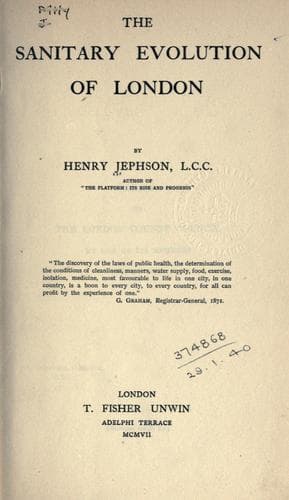
The Sanitary Evolution of LondonJephson, Henry (Henry Lorenzo)
History
The Sanitary Evolution of London
Jephson, Henry (Henry Lorenzo)
Public health -- England -- London
"It is of no avail to lament over the laws of absolute necessity, but
all parties should combine in a demand for that even-handed justice
to the working ranks which, though it may not interfere with a stern
destiny which confines them to a life of toil, is bound at least to
provide that the theatre of that toil shall be free from the pollutions
that endanger the functions of life, and uncontaminated by contagion
and death.
"I must say it is a scandal to the present constitution of society
that the reverse of this continues from year to year in spite of
all suggestions of Medical Officers of Health, and the warnings of
experience. In vain does one plague after another ravage the family of
industrial orders, and like doomed men they stand amidst the harvest of
death looking earnestly, but in vain, to the Legislature for that help
which no other power can give. Parents, children, and friends, drop
around them, the victims of a poisoned atmosphere; while they hear and
feel successive warnings, the irrevocable law of necessity fixes them
to the spot, and they cannot flee from the danger."
The Central Authority, the Metropolitan Board of Works, had, during
the decade, been doing much useful work affecting the public health,
of London, in addition to its great work, the great system of main
drainage.
It had undertaken and had completed several large street improvements
by 1870, intended to provide new and improved means of access from one
part of the town to another.
"The Board had to supply the deficiencies resulting from centuries of
neglect: it had also to keep pace as well as it could with the wants of
the ever-increasing population, and the needs of a traffic which grew
relatively even more than the population," and each work contributed
to the improvement of the public health, by facilitating and increasing
the circulation of air in crowded neighbourhoods.
Another matter, important also in reference to the health of the
metropolis, had also occupied their attention, namely, the acquisition
or preservation of open spaces in London for public recreation and
enjoyment.
A piece of land, of over 100 acres in extent, was acquired and opened
to the public as Finsbury Park in 1869; and on the south side of the
river, in Rotherhithe, some 63 acres of land were purchased in 1864,
and converted into a public park a few years later.
On the outskirts of London there were a number of commons and other
tracts of open ground available for public resort, to which the public
had no legal rights, and which were rapidly being absorbed by railway
companies or builders. London was thus in danger of losing open spaces
which were urgently required in the interests of the public health.
Public-domain text, read in full here on John Shaqi.
Reviews
Reviews
No reviews yet
Be the first to share your thoughts on this work.
Elsewhere in the archive
Join the Discussion
Join the discussion
Sign in to leave a comment or review.
Sign InorCreate an account