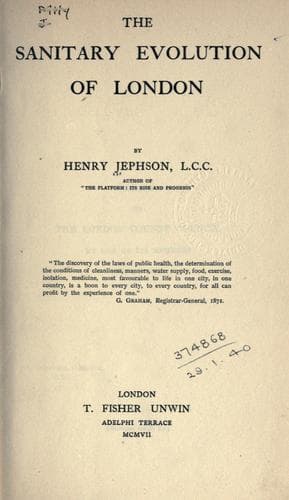
The Sanitary Evolution of LondonJephson, Henry (Henry Lorenzo)
History
The Sanitary Evolution of London
Jephson, Henry (Henry Lorenzo)
Public health -- England -- London
Parliament, after an inquiry by Select Committee, passed the
"Metropolitan Commons Act"[108] in 1866, which prescribed a mode of
procedure under which the commons in the neighbourhood of London could
be permanently procured for the people of London, and the Metropolitan
Board set to work to procure them. The acquisition of Hampstead Heath
was happily arranged in 1870.
Another great work was also undertaken by the Central
Authority--namely, the embankment of the Thames.
The offensive state of the river had been greatly enhanced by the
large areas left dry at low water on which sewage matter collected and
putrefied; and the only way of removing this cause of mischief was by
confining the current within a narrower channel.
Parliament passed an Act in 1863, entrusting its execution to the
Metropolitan Board, and the work was soon after commenced.
Thus in these matters, all of which were closely associated with the
public health, the sanitary evolution of London was progressing, and
the Board was giving visible demonstration of the necessity of that
which had so long been denied to London--namely, a central governing
authority to deal with matters affecting London as a whole.
The Board, in their report for 1865-6, stated they were: "Deeply
sensible of what remained to be done to remedy the neglect of past
ages, and to render the metropolis worthy of its position as the chief
city of the Empire;" but they were hampered by the want of means to
enable them to carry out desired improvements.
"It cannot be questioned," they wrote, "that direct taxation now falls
very heavily upon the occupiers of property in the metropolis.... It
appears to the Board that the most equitable and practicable mode
of raising the necessary funds would be by imposing a portion of
the burden on the owners of property. It cannot be denied that the
interest of the latter in metropolitan improvements is much greater
than that of temporary occupiers, and yet at the present time, the
occupiers of property in the metropolis bear almost the whole cost
of the improvements effected by the Board. It is hoped that the
representations made by the Board will satisfy the Legislature of the
injustice of the present state of things, and lead to some equitable
remedy."
The visitation of cholera was doubtless in the main accountable for the
excess of energy displayed by Parliament about this period in matters
affecting the public health.
In the same session that the Sanitary Act was passed, a measure of
considerable importance to the consumers of water in London was passed,
though many years would elapse before its effect would be appreciable.
This was "The Thames Purification Act."
Public-domain text, read in full here on John Shaqi.
Reviews
Reviews
No reviews yet
Be the first to share your thoughts on this work.
Elsewhere in the archive
Join the Discussion
Join the discussion
Sign in to leave a comment or review.
Sign InorCreate an account