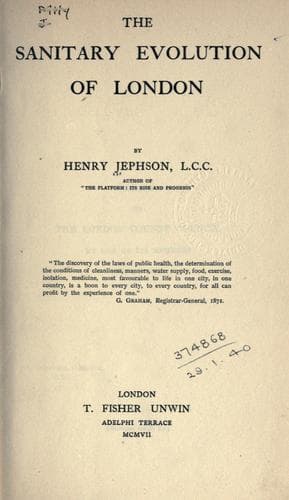
The Sanitary Evolution of LondonJephson, Henry (Henry Lorenzo)
History
The Sanitary Evolution of London
Jephson, Henry (Henry Lorenzo)
Public health -- England -- London
In the early stage of its existence its duties were strictly confined
to those of the pauper class suffering from these diseases.[110]
Admission to its hospitals could be obtained only on orders issued by
the relieving officers, and those admitted became, if they were not
so already, "pauperised" by admission and _ipso facto_ paupers; but
later its scope was extended, and it became the Hospital Authority for
infectious diseases in London, and afforded another illustration of the
necessity for having one central authority for matters relating to the
public health of the inhabitants of the metropolis.
The erection of hospitals was at once commenced. The first was
opened in January, 1870, and the isolated treatment of many cases of
infectious disease was of great benefit to the community.
In 1867, too, Parliament again dealt with the condition of the workers
in Factories and Workshops. The legislation dealt with the kingdom as
a whole, but inasmuch as London was so great a manufacturing city, it
affected also the masses of the working population of the metropolis.
The Commissioners on Children's Employment, who had been at work since
1862, had completed their inquiry, and made many recommendations, and
in the concluding part of their fifth report, dated 1866, they wrote:--
"We heartily trust that we may have thus, in some degree, contributed
to bring the time nearer when so many hundreds of thousands of your
Majesty's poorer subjects of the working classes--especially the very
young and those of the tenderer sex--will be relieved from the totally
unnecessary burden and oppression of overtime, and night work; will
be confined to the reasonable and natural limits of the factory hours
... will perform their daily labour under more favourable sanitary
conditions, breathing purer air, amid greater cleanliness, and
protected against causes specially injurious to health and tending to
depress their vigour and shorten their lives."
Only in 1867 was factory legislation at last of an approximately
general character.
"Fully two-thirds of the century in which England's industrial
supremacy swept to its climax was allowed to pass before even an
attempt was made to regulate on sound general principles the recognised
and inevitable workings of unchecked individualism in the industrial
field."[111]
The Act of 1867[112] made better provision for regulating the hours
during which children, young persons, and women, were to be permitted
to labour in any manufacturing process conducted in an establishment
where fifty or more persons are employed--the regulation being in the
direction of less onerous conditions of labour.
And by another Act passed at the same time--"The Workshop Regulation
Act, 1867,"[113] the protection afforded to workers in factories was
extended to workers in smaller establishments, so far as regarded the
regulations relating to the hours of labour to children, young persons,
and women.
"Workshop" was defined as--
Public-domain text, read in full here on John Shaqi.
Reviews
Reviews
No reviews yet
Be the first to share your thoughts on this work.
Elsewhere in the archive
Join the Discussion
Join the discussion
Sign in to leave a comment or review.
Sign InorCreate an account