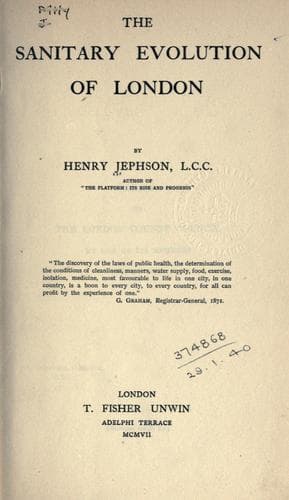
The Sanitary Evolution of LondonJephson, Henry (Henry Lorenzo)
History
The Sanitary Evolution of London
Jephson, Henry (Henry Lorenzo)
Public health -- England -- London
Indeed, any person suffering from an infectious disease might, if
willing to become a pauper, take advantage of such provision as was
made by the Guardians of the Poor, the provision being imperfectly
isolated wards and buildings attached to the several Metropolitan
Workhouses and Infirmaries. Those not so willing were compelled to
remain at home, a source of danger to those around them, and if poor,
with insufficient medical attendance and nourishment.
For a long time the only special provision for certain infectious
diseases for the whole of London was that in the London Fever, and the
London Smallpox Hospitals, both of which were maintained by private
charity.
Happily, where neither the State nor the local authorities did
anything, charity stepped in, and on a larger scale supplied an
inevitable want; and medical charities grew up to give relief in time
of sickness to those of the working classes of society who were unable
to provide for themselves, but this was mostly for non-infectious or
non-contagious diseases.
None of the Vestries or District Boards gave any sign of making
provision for those who were not paupers, although the duty of giving
opportunity for isolation of infectious persons whose diseases made
them dangerous to others, be they paupers or not, devolved upon them
under the Sanitary Act of 1866 as the Sanitary Authorities concerned in
the prevention of the extension of disease.
"Indeed it must be admitted," wrote the Medical Officer of Health for
Chelsea some years later, "that the Vestries never recognised their
responsibilities (as sanitary authorities) from the very first."
Grievous scandals having occurred in the treatment of the sick in
many of the metropolitan workhouses, the Government of 1867 decided
on a great measure of reform. Once more the necessity of central
government had to be recognised, and by the Metropolitan Poor Act of
1867 a Board--elected by the Poor Law Guardians, who themselves were
elected bodies--was created as a central authority to relieve Poor Law
Guardians of the care of and treatment of paupers suffering from fever
and smallpox who could not be properly treated in workhouses, and to
provide for their treatment and accommodation, as well as that of the
harmless insane of the metropolis.
The Board was entitled the Metropolitan Asylums Board, and consisted of
73 members; 55 of whom were elected by the various Boards of Guardians
in London, and the remaining 18 being nominated by the Home Secretary.
Public-domain text, read in full here on John Shaqi.
Reviews
Reviews
No reviews yet
Be the first to share your thoughts on this work.
Elsewhere in the archive
Join the Discussion
Join the discussion
Sign in to leave a comment or review.
Sign InorCreate an account