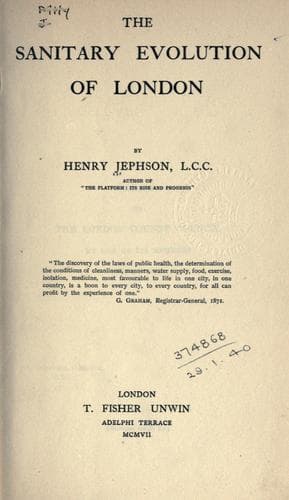
The Sanitary Evolution of LondonJephson, Henry (Henry Lorenzo)
History
The Sanitary Evolution of London
Jephson, Henry (Henry Lorenzo)
Public health -- England -- London
"If, however, we turn from contemplating the intentions of the
Legislature to consider the degree in which they are realised, the
contrast is curiously great. Not only have permissive enactments
remained for the most part unapplied in places where their application
has been desirable; not only have various optional constructions and
organisations which would have conduced to physical well-being, and
which such enactments were designed to facilitate, remained in an
immense majority of cases unbegun; but even nuisances which the law
imperatively declares intolerable have, on an enormous scale, been
suffered to continue; while diseases which mainly represent the
inoperativeness of the nuisance-law, have still been occasioning,
I believe, fully a fourth part of the entire mortality of the
country. And when inquiry is made into the meaning of this strange
unprogressiveness in reforms intended, and in great part commanded, by
the Legislature, the explanation is not far to seek. Its essence is
in the form, or perhaps I may rather say in the formlessness, of the
law. No doubt there are here and there other faults. But the essential
fault is that laws which ought to be in the utmost possible degree,
simple, coherent, and intelligible, are often in nearly the utmost
possible degree, complex, disjointed and obscure. Authorities and
persons wishing to give them effect may often find almost insuperable
difficulties in their way; and authorities and persons with contrary
disposition can scarcely fail to find excuse or impunity for any amount
of malfeasance or evasion."
To this review by one of the ablest and most experienced of men of
the time in matters relating to the public health, it must, however,
be added that so far as the metropolis was concerned, "the meaning of
this strange unprogressiveness" was not so much the formlessness of the
law, as the fact that the interests against the enforcement of many
portions of the law were predominant, and the non-administration of the
law was due far more to that circumstance than to any ambiguities or
obscurities in the laws. "Vested interests in filth and dirt" were all
powerful on the greater number of the local authorities of London, and
so the law which would have interfered with those interests was left
severely unadministered.
Against these interests it was difficult to struggle--especially
when there was no compulsion upon the administrators of the laws to
administer them. Sheltered under a permissive, they would not exercise
a compulsory power--a power entrusted to them with the control of
public money for public good.
The true cause of the inoperativeness of the law was, in a way, pointed
out by the Medical Officer of Health for St. James', Westminster, when
he wrote (1869-70):--
Public-domain text, read in full here on John Shaqi.
Reviews
Reviews
No reviews yet
Be the first to share your thoughts on this work.
Elsewhere in the archive
Join the Discussion
Join the discussion
Sign in to leave a comment or review.
Sign InorCreate an account