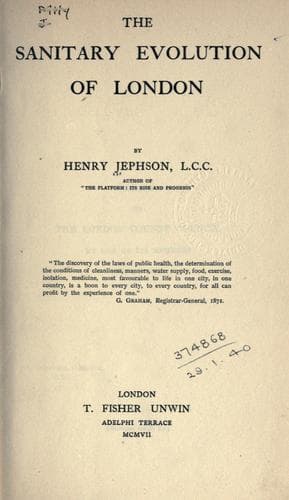
The Sanitary Evolution of LondonJephson, Henry (Henry Lorenzo)
History
The Sanitary Evolution of London
Jephson, Henry (Henry Lorenzo)
Public health -- England -- London
"The great deficiency of the Act of 1866, as of all other English
legislation on sanitary matters, is that no public prosecutor is
appointed. If Vestries neglect to prosecute, and individuals do not see
their way to it, people may be killed by infectious diseases to any
extent."
And the Medical Officer of Health for St. Giles' expressed a similar
opinion when he wrote (1870):--
"The duty of making these sanitary improvements should be imperative
instead of permissive. It was wise, at first, perhaps, that our
sanitary legislation should be tentative and experimental; but
experience having proved its necessity it should be made more
stringent."
But neither of them got so far as to see the natural and simple remedy,
that where a local authority for one reason or another would not
administer the laws made by Parliament, the central authority should
step in and do the work at the cost and expense of the recalcitrant
local authority.
If one set of people failed in their duty to the public, it was but
right that where such tremendous issues were at stake as the health and
physical well-being, not merely of the people of one parish but of over
three and a quarter millions of people--and all that their health and
well-being implied--the administration of the law should be placed in
hands that would administer it.
That, however, was but part of the great problem, though it would have
gone a long way in ameliorating things. The other necessity was the
strengthening and altering of the law which itself stood in need of
many and large changes before a sure foundation could be laid for the
future health of the great community resident in the great metropolis
of London.
And other matters which ultimately were to have great influence towards
the solution of some of the worst of the health difficulties in London
were coming into view, and assuming form and substance.
Tramways, with their facilities of traffic, were about to be started.
In 1869 three private Acts were passed, authorising the construction
and working of tramway lines in the metropolis, and in the following
year several more private Acts and "The Tramways Act, 1870," which
was a general measure. Its main object was to provide a simple,
inexpensive, and uniform mode of proceeding in obtaining authority for
the construction of tramways, and to give the local authorities the
power of regulation and control.
In London the Metropolitan Board of Works was constituted the "local
authority" under the Act; and that Board was empowered to apply for
a Provisional Order itself to construct tramways, and lease them to
other persons, and was given, with the approval of the Board of Trade,
a compulsory power of purchase after a period of twenty-eight years on
certain conditions.
Public-domain text, read in full here on John Shaqi.
Reviews
Reviews
No reviews yet
Be the first to share your thoughts on this work.
Elsewhere in the archive
Join the Discussion
Join the discussion
Sign in to leave a comment or review.
Sign InorCreate an account