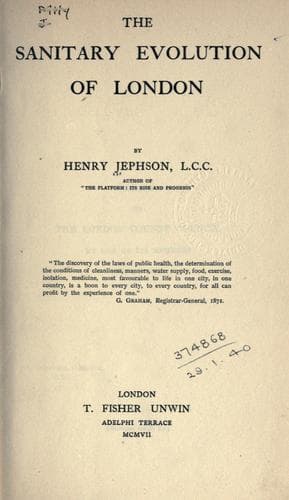
The Sanitary Evolution of LondonJephson, Henry (Henry Lorenzo)
History
The Sanitary Evolution of London
Jephson, Henry (Henry Lorenzo)
Public health -- England -- London
[102] Select Committee on Metropolitan Local Government.
[103] See P.P. 1867-8, vol. lviii. Return of Inspectors of Nuisances,
&c., 1866.
[104] Select Committee on Metropolitan Local Government, 1866.
[105] P.P. 1867, vol. xxxvii.
[106] P.P., vol. xxxvii. p. 275.
[107] 29 and 30 Vic. cap. 90.
[108] 29 and 30 Vic. cap. 122.
[109] 6 and 7 Wm. IV. cap. 86.
[110] See Report of the Metropolitan Asylums Board for 1886-7.
[111] See the Edinburgh Review, January, 1903.
[112] 30 and 31 Vic. cap. 103.
[113] 30 and 31 Vic. cap. 146.
[114] Report of Select Committee on the working of the Artizans' and
Labourers' Dwellings Improvement Act, 1882, p. iii.
[115] Ibid., p. iv.
[116] P.P. 1868-69, vol. 32.
CHAPTER IV
1871-1880
IN 1871, the decennial Census once more afforded reliable information
as to the population of London, and gave the means of ascertaining much
else of the greatest value.
The population had gone up to 3,254,260 in 1871, from the 2,808,862 it
had been in 1861, an increase of 445,398. But the rate of increase was
declining. The decennial increase of population which had been 21·2 in
1841-1851, 18·7 in 1851-1861, had further declined to 16·1 in 1871.
The returns showed that London contained 2,055,576 persons born within
its own limits, and 1,198,684 persons born outside its borders.
"Whence came these multitudes of both sexes, equal in themselves,
without counting those born there, to a number greater than the
inhabitants of any other European city?"
More than 607,000 of them came from the chiefly agricultural eastern,
south-eastern, and south-midland counties surrounding the metropolis.
A large contingent of 147,000 was drawn from Devonshire, Wiltshire,
Somersetshire, and the other south-western counties.
The west-midland counties sent up 84,000.
41,000 persons had come from Scotland, 91,000 from Ireland, 20,000 from
the Colonies, and 66,000 from foreign parts.
In fact, over 37 per cent. of the population of London in 1871 were
immigrants into the great metropolis--a great rushing river of
humanity.
The returns were also of special interest in showing the changes in
the distribution of the population. Speaking broadly, the previous
movements were being continued--a diminishing population in the central
parts, an increasing population in the outer parts.
It appeared to be inevitable that--
"As the trade of London continued to increase, so the districts which
lay close to the great centres of business must be expected to be
occupied more and more with warehouses, and less and less with the
miserable dwelling-houses which had hitherto sheltered its poor and
working-class population."
The diminution of the population of the central parts of London was in
no way a symptom of decay: it was, in reality, proof of the reverse,
being the result of increasing trade, commerce, and wealth, which
required more house accommodation for the carrying on of their enormous
operations.
Public-domain text, read in full here on John Shaqi.
Reviews
Reviews
No reviews yet
Be the first to share your thoughts on this work.
Elsewhere in the archive
Join the Discussion
Join the discussion
Sign in to leave a comment or review.
Sign InorCreate an account