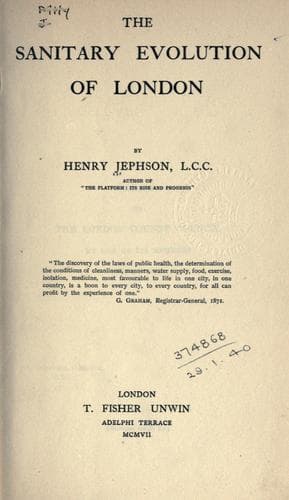
The Sanitary Evolution of LondonJephson, Henry (Henry Lorenzo)
History
The Sanitary Evolution of London
Jephson, Henry (Henry Lorenzo)
Public health -- England -- London
The great economic forces were in fact as active and powerful as ever.
In the City the population had fallen in the decade from 111,784 to
74,635. In every one of the six parishes or districts composing the
Central group the population had likewise decreased.
In the Eastern group, the population of three had decreased, whilst
in the others there were increases--notably so in Poplar, where there
was an increase of 37,000, and in Bethnal Green, where there was an
increase of 15,000.
In the Northern group all had increased, except St. Marylebone--the
increase in Hackney being over 41,000, and in Islington over 58,000.
In the West, there were also large increases--Fulham 27,000, Paddington
21,000, Kensington 50,000. Only St. James' (Westminster) and
Westminster had decreased, and they in reality belonged more to the
centre than to the west.
On the South side, with the exception of Christchurch, St. Olave, and
St. Saviour's--all in Southwark--and Greenwich, there was an increase
in all the parishes or districts, the increases in some being very
large; 40,000 in Camberwell, 46,000 in Lambeth, 55,000 in Wandsworth.
The figures thus furnished by the Census enabled a fairly accurate
calculation to be made as to the death-rate. It now appeared to be 24·6
per 1,000 living.
The Registrar General, in his report for 1873, entered into a
comparison with previous years which may be assumed to be as accurate
as any such calculations could be.
The mortality was as high as 29·4 in 1854. It was 26·5 in 1866 (when
cholera was epidemic), and it was as low as 21·5 in 1872, and 22·5 in
1873.
"The mortality never having been so low in any two consecutive years
since 1840, and by fair inference never so low in any two years since
London existed."
This was distinctly encouraging, demonstrating as it did the good
results ensuing upon the great works of improved drainage and sewerage,
and a healthier water supply.
As to the housing of this huge population, it was shown that the number
of inhabited houses had increased from 360,035 to 419,642.
The reports of many of the Medical Officers of Health throw much
additional light upon, and explain or elucidate the facts set out in
the Census, and carry on the narrative into later years of the matters
recorded by the Census Commissioners.
Thus, as regarded the reduction of the population in the central group
of parishes, the Medical Officer of Health for the Strand District
ascribed it in part to the new Law Courts, and to the circumstance that
residential houses were, in increasing numbers, becoming converted into
business premises.
"But," he added, "it is also probably in some measure due to the
greater facilities for locomotion to suburban homes"; which is notable
as almost, if not absolutely, the first recognition of this cause
affecting the population.
Public-domain text, read in full here on John Shaqi.
Reviews
Reviews
No reviews yet
Be the first to share your thoughts on this work.
Elsewhere in the archive
Join the Discussion
Join the discussion
Sign in to leave a comment or review.
Sign InorCreate an account