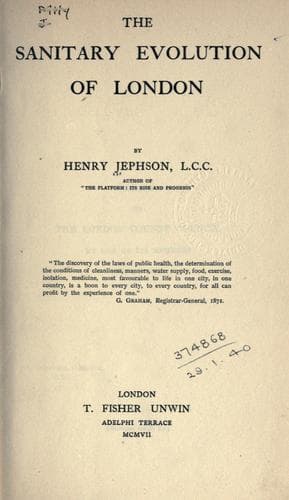
The Sanitary Evolution of LondonJephson, Henry (Henry Lorenzo)
History
The Sanitary Evolution of London
Jephson, Henry (Henry Lorenzo)
Public health -- England -- London
In St. James', the decrease of population was "due to the fact that
the district had increasingly become the centre for clubs, hotels,
and splendid shops. The result had been an enormous rise in the value
of houses, and a gradual extrusion of the less wealthy and important
residents."
In St. George-in-the-East, the Medical Officer of Health stated that:--
"The decrease of population was due to houses being taken by a railway
company, by the Poor Law Guardians for an infirmary, for a church, &c."
How considerable the clearances were in some districts may be inferred
from the figures given by the Medical Officer of Health for St. Giles'
in 1871.
"The clearances in the City of London for the purposes of erecting a
new market, and a viaduct, and in the Strand district to form a site
for the proposed Law Courts, have aggravated the evil of overcrowding.
To effect these improvements (or chiefly so) the large number of 18,358
persons have been removed. Strand, 6,998; St. Sepulchre (City), 4,188;
St. Bride (City), 4,211; Saffron Hill, 2,961."
And in St. Olave, on the south side of the river, the Medical Officer
of Health wrote:--
"Since the census of 1861, 436 houses have been pulled down, clearing
away whole streets and courts for the formation of railways and the
extension of warehouses, displacing 961 families comprising 3,556
persons."
Consequent upon these clearances, and the people having to find
dwelling room somewhere, the transition of houses built for a single
family into tenement-houses continued in full swing.
The Medical Officer of Health for St. Mary, Newington, reported (1873)
that year by year the better class of houses were becoming less and
less inhabited by a single family.
The Medical Officer of Health for Paddington gave a very clear
description of the process.
"There is a very dense packing of population," he wrote (1873), and he
mentioned some instances:--
"Brindley Street with 801 persons living in 65 houses.
Hampden Street " 876 " " 78 "
Waverley Road " 900 " " 72 "
"Builders intended these houses at first for one respectable family,
but ... in violation of common sense and decency they are let out in
tenements and single rooms, without those essential conditions of
a dwelling which landlords should in all instances be compelled to
provide.
"There is yet in reality no law to prevent the creation of unhealthy
districts as long as five or six families are allowed to live in one
house intended for a single family.... Houses should be built with
reference to the future health of the people who will have to live in
them.
"And now, while the fields are open and still unbuilt upon, it would be
worth the attempt to overcome the destructive influences likely to be
established in building tenement dwellings as the population gathers
in this and other neighbourhoods. They will some day be hives of
pauperism."
Public-domain text, read in full here on John Shaqi.
Reviews
Reviews
No reviews yet
Be the first to share your thoughts on this work.
Elsewhere in the archive
Join the Discussion
Join the discussion
Sign in to leave a comment or review.
Sign InorCreate an account