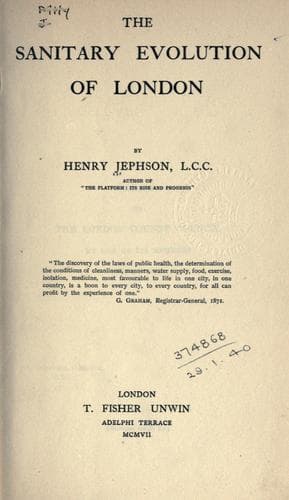
The Sanitary Evolution of LondonJephson, Henry (Henry Lorenzo)
History
The Sanitary Evolution of London
Jephson, Henry (Henry Lorenzo)
Public health -- England -- London
"Many of the underground kitchens in Leinster Street (and four others
named) have been inspected where the poor people are found living like
Esquimaux in underground cave dwellings--places with impure air, want
of light, admitted only through a grating in front, the upper sash of
the window being often out of repair, or nailed up."
The rapid increase of population in London would not have been
accompanied with such serious results to the public health as it was,
if the houses which were being so rapidly built for the people to
inhabit had been constructed on sound sanitary principles.
But this was very far from being the case, and the evils described in
the last chapter in this respect continued over an enlarged area, and
in accentuated form.
It is now almost incredible that the laws should have been left in
such a state as to enable builders, without any legal check, to put up
the houses they did.
The Medical Officer of Health for Mile-End-Old-Town pointed out (in
1872) that "The position and structure of houses has a very distinct
bearing upon the public health, yet very little regard is given to
sanitary principles in their construction.... The class of small
houses for the crowded occupation of the poorer classes is generally
built either upon 'made ground' composed of refuse and débris of all
descriptions, the organic portion of which presently fills the houses
with various disease-producing gases, or upon newly opened ground
saturated with miasma, without the least attempt at protection by means
of previous drainage or properly protected excavated foundations."
And in 1876 he reverted to the subject:--
"Water, air, and light are nature's disinfectants and preventions
of disease. They are abundantly provided, but more meagrely and
inefficiently used, and indeed practically ignored, by architects,
builders, owners, and occupiers...."
A witness before a Select Committee testified in 1874[117] that:--
"Houses were being built upon the soil--any soil, in point of fact--and
the foundations of houses consisted very often of nothing but manure,
and old boots, old hats, or anything thrown into it."
The Medical Officer of Health for Poplar wrote (1873):--
"The continued rapid increase in the number of new streets and houses
in various parts of the district presents many unsatisfactory features.
"In most cases, before the buildings are commenced, the gravel is
dug out, and the hole filled up with so-called brick rubbish, but in
reality with road-sweepings, the siftings of the dust yards and similar
refuse. The dwelling-houses, mostly of the poorer class, are largely
built of soft ill-burnt bricks, and are tenanted generally as soon as
they are finished--frequently even before they are complete.
"As a matter of course the walls are still damp, the streets unpaved,
and the residents suffer often very seriously in their health."
Public-domain text, read in full here on John Shaqi.
Reviews
Reviews
No reviews yet
Be the first to share your thoughts on this work.
Elsewhere in the archive
Join the Discussion
Join the discussion
Sign in to leave a comment or review.
Sign InorCreate an account