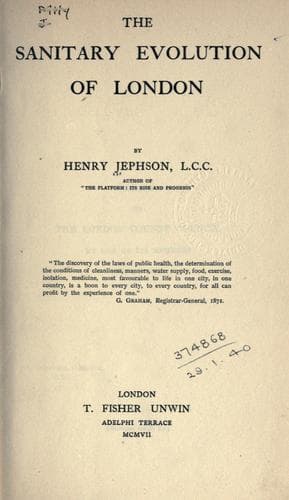
The Sanitary Evolution of LondonJephson, Henry (Henry Lorenzo)
History
The Sanitary Evolution of London
Jephson, Henry (Henry Lorenzo)
Public health -- England -- London
The Medical Officer of Health described ten acres of houses in Hackney
as "almost entirely built upon a great dust heap," built, too, of
porous bricks and bad mortar.
And another witness before a Select Committee in 1882 described how, in
the other end of London--in Wandsworth--on an estate "which practically
might be considered a small town," the ground has been filled in to a
depth of six or seven feet with filth of every description, and houses
have been rapidly built upon it. The results to the health of the
inhabitants were disastrous.
This, however, by no means completed the description of the evil
condition of the buildings.
The Medical Officer of Health for Shoreditch wrote (1876-7):--
"Not only was the health of the inhabitants endangered by the presence
of a large number of old decayed brick drains, but also by many new
drains which had been carelessly laid. Their joints leaked; in some
places neither cement nor clay had been used, and pipes had been
connected with drains at right angles."
And the Medical Officer of Health for St. George-the-Martyr added his
testimony (1877-8):--
"Not only may the materials of which our buildings are constructed
be thus defective, but the drainage may be and is indeed mostly laid
carelessly and imperfectly.... An eminent Civil Engineer, one who has
had a very large experience in this division of his profession, informs
me that 90 per cent. of the houses built are imperfectly drained,
that the drains are laid in a reckless manner, the joints often not
cemented, and that the way in which they are laid is unscientific and
dangerous. No wonder we have continued ill-health of the occupants."
The Medical Officer of Health for Fulham described in 1872-3 how in
"Fulham New Town" the basements of the houses had been built below any
available sewerage, with the result of constant floodings of cesspool
matter to the great danger of the public health.
And the materials of which the superstructure was made were as bad as
they well could be. Porous, and half baked, and broken bricks being
used, and mortar mixed with garden mould or road scrapings--"some
without a particle of lime in it."
In Battersea Fields--
"You will find them there putting the houses together in such a way
that you may kick the walls down with your feet."[118]
The Medical Officer of Health for Whitechapel put the subject very
tersely when he wrote in 1880:--
"In the construction of houses the only thing that appears to be
considered is that of cheapness."
Until near the end of this decade of 1871-1881, a building could be
constructed without any supervision of the materials, and any number
of structures which could not be occupied without danger to life or
health might be put up, for no one had power to interfere. The London
Building Act had no adequate clauses to secure the effectual purity of
new dwellings, nor had the Sanitary Authority any power to check the
practice of building houses on rotten filth.
Public-domain text, read in full here on John Shaqi.
Reviews
Reviews
No reviews yet
Be the first to share your thoughts on this work.
Elsewhere in the archive
Join the Discussion
Join the discussion
Sign in to leave a comment or review.
Sign InorCreate an account