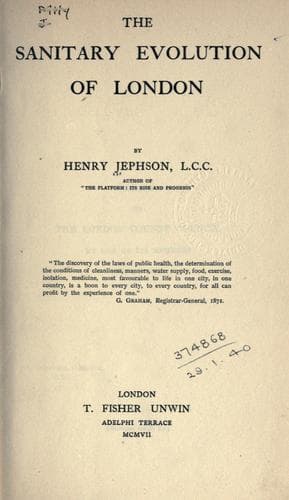
The Sanitary Evolution of LondonJephson, Henry (Henry Lorenzo)
History
The Sanitary Evolution of London
Jephson, Henry (Henry Lorenzo)
Public health -- England -- London
"The necessity for re-vaccination when the protective power of primary
vaccination has to a great extent passed away, cannot be too strongly
urged. No greater argument to prove the efficacy of this precaution
can be adduced than that out of upwards of 14,800 cases received into
the hospitals, only four well-authenticated cases were treated in
which re-vaccination had been properly performed, and these were light
attacks."
Parliament passed an Act in 1871, making the appointment of paid
Vaccination Officers compulsory on all Guardians, and the law generally
more effective.
Likewise in 1871 Parliament dealt with another matter affecting the
public health, and placed on record its opinion of the Vestries and
District Boards by relieving them of the duty of enforcing the sanitary
provisions of the Workshops Act, which they had failed to carry out,
and transferring it to Government Inspectors appointed by the Home
Secretary.
This was quite an unprecedented amount of sanitary legislation by
Parliament in one year, and is very notable as showing the greater
position health matters were assuming in the opinion of the nation, and
the greater necessity Parliament felt itself under for dealing with
them.
An improvement as regarded the food of the people of the metropolis was
also commenced about this time.
The Corporation of the City of London had undertaken to carry out
the provisions of Part III. of the Contagious Diseases Animals Act,
1869,[122] and had purchased the site of Deptford Dockyard for the
purpose of a cattle market, and for the reception and slaughter of
foreign cattle. The market was opened in 1871, and the system of
inspection there inaugurated secured the good quality of a great
portion of the meat consumed in London.
In the following year (1872) the purity of certain articles of the food
and drink of the people engaged the attention of Parliament.
Under the Act of 1860 the Vestries and District Boards might each
appoint an analyst, but the great majority of them availed themselves
of the permissive character of the Act, and did not appoint one.
A sidelight is thrown upon the effect of this inaction of the local
authorities by evidence given in 1862 by a master baker named W.
Purvis. He said:--
"When the Act passed for preventing the adulteration of articles of
food and drink there was an immediate apprehension among those bakers
in the trade who adulterate their bread that they would be liable to
have their bread frequently analysed, &c. But when it was found that
no sufficient means were provided by the Act to meet the expenses of
this kind of active and constant supervision (the purchaser having to
pay the analyst), they became confident again, and have resumed their
practice of adulteration without any fear of detection."[123]
It was felt now that some further move should be made, and Parliament
added another Act for preventing the adulteration of food, drink, and
drugs to the long list of those which had gone before.
Public-domain text, read in full here on John Shaqi.
Reviews
Reviews
No reviews yet
Be the first to share your thoughts on this work.
Elsewhere in the archive
Join the Discussion
Join the discussion
Sign in to leave a comment or review.
Sign InorCreate an account