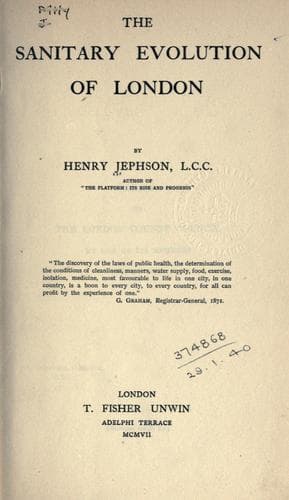
The Sanitary Evolution of LondonJephson, Henry (Henry Lorenzo)
History
The Sanitary Evolution of London
Jephson, Henry (Henry Lorenzo)
Public health -- England -- London
Little, however, was done either by the Metropolitan Board of Works,
the Board of Trade, or the companies to avail themselves of the
optional provisions of the Act.
"Perhaps," wrote the Medical Officer of Health for Wandsworth, "there
never was an Act of Parliament so completely ignored in many districts
as the one in question."
"The companies," wrote another Medical Officer of Health, "are too busy
in looking after their trade interests to concern themselves much about
the health of the people."
And the constant supply to the people of London was postponed to the
distant future.
In 1871 another subject also claimed the attention of Parliament.
An epidemic of smallpox of unexampled severity began at the end of
the year 1870, "the like of which had not been known in England since
vaccination was first practised." It increased in London at an alarming
rate until it reached its height in May, 1871, when 288 people died of
it in one week, and it killed in London alone, in that one year, 7,876
persons. And as it was reasonable to assume that one death represented
at the very least eight or ten times the number of cases of that most
loathsome disease, the results were frightful, and the injury inflicted
upon the community, present and future, disastrous.
At one time more than 2,000 smallpox patients were under the care of
the Metropolitan Asylums Board, and the admissions into the Board's
hospitals about the same time averaged 500 a week.
In a report on the subject the Committee of the House of Commons
wrote:--
"It is impossible to say what ravages might not have been the result
of the smallpox epidemic of 1870-1 had it not been for the efficiency
and energy of the Asylums Board. Although the prophylactic virtues of
vaccination have been recognised on all sides, it must be remembered
that as yet but a small part of the growing population has been
subjected to the operations of the Compulsory Vaccination Act."
And they expressed "their strong sense of the great services rendered
to the metropolis by the managers."
The prevention of smallpox by vaccination was not yet a very potent
factor in the diminution of that disease. Only slowly could the
Compulsory Vaccination Act of 1867 produce effect, and as the
appointment of public vaccinators and the establishment of vaccination
stations had been made only optional, the mortality of the outbreak in
1870-1 had been but little, if at all, modified by it. The epidemic,
however, was used by some to enforce a lesson.
Thus the Medical Officer of Health for St. James' wrote:--
"The lesson of the great epidemic of smallpox is the necessity for
vaccination.
"The history of no other disease supplies so assuredly and necessarily
the means of its entire destruction."
And the managers of the Metropolitan Asylums Board, in a report issued
in 1871, wrote:--
Public-domain text, read in full here on John Shaqi.
Reviews
Reviews
No reviews yet
Be the first to share your thoughts on this work.
Elsewhere in the archive
Join the Discussion
Join the discussion
Sign in to leave a comment or review.
Sign InorCreate an account