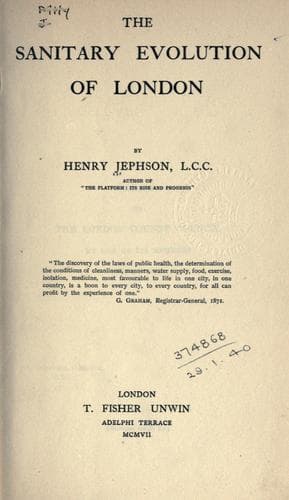
The Sanitary Evolution of LondonJephson, Henry (Henry Lorenzo)
History
The Sanitary Evolution of London
Jephson, Henry (Henry Lorenzo)
Public health -- England -- London
In the section of river lying between London Bridge and Woolwich
Arsenal Pier, about 10 miles in length, there was a constant average of
no less than 400 vessels of all descriptions moored on both sides of
the river, more than 90 per cent. of which had crews on board.
The creeks were more or less occupied by barges containing manure,
street-sweepings, gas-liquor, bones and other varieties of foul
cargoes, inasmuch as depôts for the storage of these materials existed
on the banks.
And lying in the docks there was an average of between six to seven
hundred vessels, over none of which had the sanitary authorities on the
sides of the river any control whatever.
This was a most unsatisfactory condition of things, and left London
open to the practically unchecked importation of infectious and
contagious disease of every kind.
By "Provisional Order" of the Local Government Board, the Corporation
of London was constituted the Sanitary Authority of the Port of
London,[126] and was made responsible not only for taking proper steps,
under Orders in Council, to prevent the introduction of cholera,
but was required also to carry out, within its allotted area, the
provisions of the various Nuisances Removal Acts and Prevention of
Diseases Acts for England, and the Sanitary Act of 1866.
Its authority extended only to things afloat. Whatever was landed came
within the province of the local Sanitary Authority, except things
landed in the docks, and things "in bond," which were under the control
of Her Majesty's Customs.
The work was undertaken at considerable expense by the Corporation out
of the City's cash, and at no charge to the ratepayer.
And a Medical Officer of Health for the Port and some Inspectors were
appointed.
It was the duty of the Port Medical Officer--
"To inspect, before landing, all emigrants that arrived in the Port
from the Continent for purposes of transhipment, and to isolate all
suspected cases, and to carry out all Special Orders in Council
relating to the prevention of cholera, or other epidemic diseases."
He was also charged with the duty of inspecting, at Gravesend, any
cases of sickness on inward-bound vessels reported to the authorities
by the officers of Her Majesty's Customs.
As to the prevention of the importation of epidemic diseases other
than cholera, reliance was placed upon a speedy and proper examination
of vessels as soon as possible after they had come to moorings. A large
proportion of these vessels required constant general inspection.
Among the various other duties, fumigation and disinfection of vessels,
also of clothing, were not the least important.
For isolation of the sick a hospital ship was maintained at Gravesend.
Public-domain text, read in full here on John Shaqi.
Reviews
Reviews
No reviews yet
Be the first to share your thoughts on this work.
Elsewhere in the archive
Join the Discussion
Join the discussion
Sign in to leave a comment or review.
Sign InorCreate an account