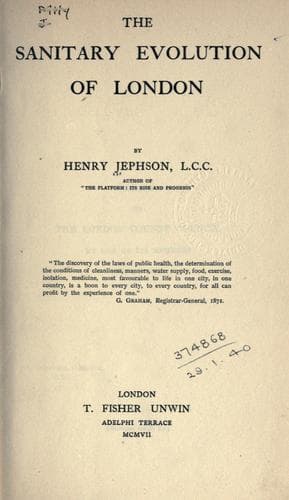
The Sanitary Evolution of LondonJephson, Henry (Henry Lorenzo)
History
The Sanitary Evolution of London
Jephson, Henry (Henry Lorenzo)
Public health -- England -- London
The work done by the Port Authority was, in spite of many limitations
and difficulties, considerable; and the inspection of thousands of
ships, the cleansing and fumigation of foul or infected vessels, the
removal to hospital of seamen suffering from infectious or contagious
disease, and the disinfection of clothing were, sanitarily, of the
greatest advantage to the inhabitants of the metropolis.
In another matter Parliament, in 1872, made a completely new departure.
It declared that "it was expedient to make better provision for the
protection of infants entrusted to persons to be nursed or maintained
for hire or reward in that behalf." And it inaugurated a plan for
the protection of the health of the most helpless of its numerous
charges--a plan embodied in the Infant Life Protection Act.
"Houses of persons retaining or receiving for hire two or more infants
for the purpose of nursing must be registered."
The Local Authority (the Metropolitan Board of Works) was to cause a
register to be kept and make bye-laws, and might refuse to register an
unsuitable house.
And the registered owner must keep a register of the children, &c., &c.
If proved to the satisfaction of the local authority that such person
has been guilty of serious neglect, or is incapable of providing the
infants with proper food and attention, the house might be struck off
the Register, and penalties be imposed--six months with hard labour,
and up to £5 fine.
The start made was slow, only six houses having been registered in
1876; but the Act laid the foundations of a scheme which has had
considerable developments.
Specially valuable is it to have the views of one of the foremost men
of his time upon the phase of opinion existing at this period upon the
general question of the public health. They help to mark progress along
the road. The late Mr. W. E. Forster, speaking at the meeting of the
British Association at Bradford in 1873, said:--
"I think our aims in this direction are higher than they used to be.
We are aiming not only at preventing death, but at making life better
worth living by making it healthy. And we no longer forget that in
fighting our battle against disease it is not only those who are killed
that are merely to be considered, but also the wounded. In those
terrible inflictions of preventable disease throughout the country
the loss of life is very sad; but even more sorrowful to my mind are
the numbers of our fellow-creatures--fellow-countrymen and women--who
are doomed to struggle and fight the battle of life under the most
severe conditions because of wounds they have received from preventable
diseases."
While Parliament was thus legislating on several matters considerably
influencing the sanitary well-being of the people of the metropolis,
the powerful economic and social forces also affecting it were silently
and uninterruptedly continuing their work with never-ceasing energy.
Public-domain text, read in full here on John Shaqi.
Reviews
Reviews
No reviews yet
Be the first to share your thoughts on this work.
Elsewhere in the archive
Join the Discussion
Join the discussion
Sign in to leave a comment or review.
Sign InorCreate an account