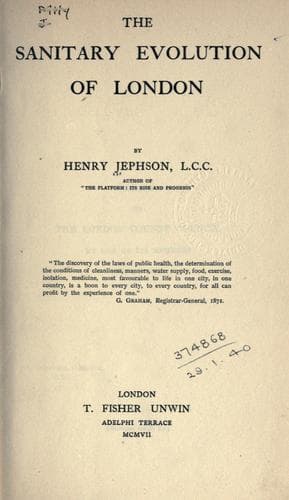
The Sanitary Evolution of LondonJephson, Henry (Henry Lorenzo)
History
The Sanitary Evolution of London
Jephson, Henry (Henry Lorenzo)
Public health -- England -- London
With the marvellous industrial developments of the time, trade, and
commerce, and businesses of various kinds and sorts were spreading over
a wider area, and constantly claiming accommodation to carry them on;
and the process continued of the conversion of residential houses into
offices and shops and warehouses and workplaces.
The increase of houses in other parts of London, rapid as it was,
barely kept pace with the increase of population, whilst it had
practically done nothing as yet to relieve overcrowding in the central
parts of London.
The excessive density of the population was a great sanitary evil.
"It is a well established law," wrote the Registrar General in 1872,
"that, other things being equal, the insalubrity of a place increases
with the density of the population, and that the fevers generated in
crowded dwellings have a tendency to spread among the whole of the
population."
And it was already pretty generally recognised by Medical Officers of
Health that the chief condition affecting the mortality of a locality
was the density of population.
The Medical Officers of Health never ceased pointing out the evils of
overcrowding.
"Overcrowding," wrote the Medical Officer of Health for Whitechapel
in 1877, "concerns the whole community, as is strikingly shown
by the spread of many diseases which are, perhaps, in the first
instance endemic, and confined to these overcrowded places, but
which soon become epidemic and extend over large areas, attacking,
indiscriminately, all classes."
And their reports are full of instances which had come under their
observation.
Thus, in 1871, the Medical Officer of Health for Whitechapel wrote:--
"At No. 13, Goulston Street, I found in the back room of the ground
floor, closely contiguous to three closets and a dust hole, one man,
six women, and three children sleeping there. The room measured
12 × 9 × 7 feet, giving only a cubic space of 756 feet for ten persons."
He mentioned also "a room in Cooper's Court, occupied by man, wife, and
seven children, which contained about 630 cubic feet of space, which
allows only 70 feet for each."
And numerous other cases of overcrowding and indecent occupation, and a
case in which the dead body of a child had been retained in a room for
fifteen days.
Passing on to the larger aspects of this dreadful overcrowding, he
wrote:--
"It is manifest that persons living in such circumstances must become
so enfeebled in health as to be unfit for any employment which requires
much physical strength. The mental capacity of such persons is also
so low as to prevent them earning a livelihood in any occupation
requiring much thought, and the consequence is an increase of paupers
or of criminals, or perhaps of both."
"Consumption and the whole tubercular class of disease are chiefly
caused by the defective ventilation of dwelling-houses, and
particularly of sleeping rooms, in which at least one-third of one's
existence is passed."
Public-domain text, read in full here on John Shaqi.
Reviews
Reviews
No reviews yet
Be the first to share your thoughts on this work.
Elsewhere in the archive
Join the Discussion
Join the discussion
Sign in to leave a comment or review.
Sign InorCreate an account