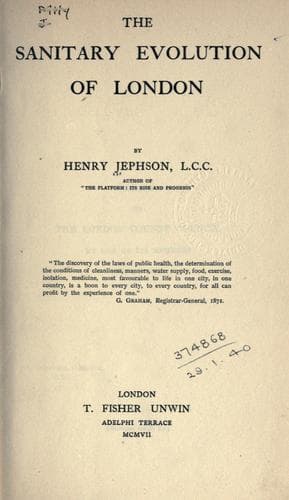
The Sanitary Evolution of LondonJephson, Henry (Henry Lorenzo)
History
The Sanitary Evolution of London
Jephson, Henry (Henry Lorenzo)
Public health -- England -- London
"This is not a school--it seems a baby-farm. Seventeen children in a
small, filthy hovel. There were four infants a few months old; one lay
on a small bed, another in a small cot, and the two others in positions
which I cannot here describe. The little ones were quite naked. The
woman who pretends to look after this 'school' was engaged in a back
yard washing. From the woman down to the infant, all here seemed
steeped in ignorance and wretchedness."
Here is a case reported by the Medical Officer of Health for
Whitechapel, so late as 1880:--
"A schoolroom at 11, Pelham Street, Spitalfields; 9 feet long × 8 × 8.
There were twenty-five children aged 4-7, and the master and his wife,
in all twenty-seven persons, giving 21·3 cubic feet for each."
And here is a report of an early crêche, or baby farm, also in
Whitechapel, in 1879:--
"The Sanitary Inspector found on the ground floor of 24, Freeman
Street, Spitalfields, a woman and twenty-five children all under three.
They were left in charge of the occupier of the room from nine until
5.30 p.m., who was paid 3d. per week per child. The room was 15 feet ×
7 × 7, thus affording 28 cubic feet of space per child!! The room was
badly ventilated, there were neither chairs nor seats, the children
were on the floor, which was in a wet and dirty condition."
The other causes of insanitation were also flourishing. "Noxious
businesses" of various kinds continued to pollute the atmosphere,
despite legislation against them, and the existence of local
authorities charged with the administration of that legislation--a
permanent pollution all the year round, and from which there was no
getting away.
Very commonly the arches under the railways were used for making and
storing artificial manures, the smell from which was intolerable.
The Medical Officer of Health for St. Mary, Newington, 1871:--
"The private manure-mixing yards have ever been the cause of much
annoyance and illness to those living in the neighbourhood. One of
these," he added, "had for years been complained of."
And yet the Vestry had not shut it up. And the air was tainted and
vitiated by the emanations from them, the owners having no vestige of
regard for other people's health.
Another cause of insanitation was the existence of slaughter-houses
throughout London, in the most crowded parts, and in close propinquity
to dwelling-houses; indeed, in the yards of some of them were
slaughter-houses, with all their unpleasant concomitants. Cow-houses,
too, also close to houses, were numerous, and, in the outer parts of
London, even piggeries.
A great opportunity was lost in 1874 for greatly diminishing, if not
actually terminating, the great "nuisance" of slaughter-houses.
Public-domain text, read in full here on John Shaqi.
Reviews
Reviews
No reviews yet
Be the first to share your thoughts on this work.
Elsewhere in the archive
Join the Discussion
Join the discussion
Sign in to leave a comment or review.
Sign InorCreate an account