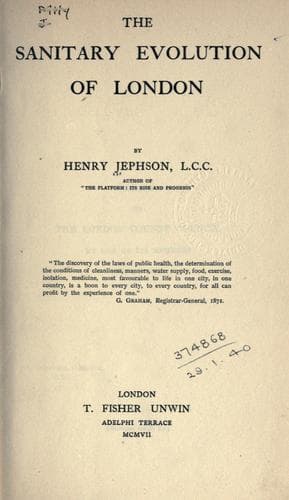
The Sanitary Evolution of LondonJephson, Henry (Henry Lorenzo)
History
The Sanitary Evolution of London
Jephson, Henry (Henry Lorenzo)
Public health -- England -- London
By an Act passed in 1844, it was declared absolutely illegal, on the
expiration of thirty years after the passing of the Act, to carry on
certain noxious businesses in any premises nearer a dwelling-house
than 50 feet, or nearer a public way than 40 feet--the business of
slaughtering being among the number. Until 1851 there was no control
over slaughter-houses; any one could conduct a slaughter-house who
pleased, subject only to the common law as to doing anything which
might be considered a nuisance.[128]
The Metropolitan Market Act, passed in that year, required that all
slaughter-houses should be licensed by the justices, thus establishing
some form of control over them.
When, in 1874, the expiration of the thirty years drew nigh, doubts
were raised by those interested in their continuance as to the
interpretation of the Act of 1844. The Select Committee, which was
investigating the subject of "Noxious Businesses," stated that no
evidence had been given before it to show that any of these trades
when properly conducted affect the health of the persons living near
the premises, and Parliament, accepting this view, passed an Act
which undid the enactment of 1844, and allowed slaughter-houses to be
continued indefinitely under license. At the same time it conferred on
the central authority, the Metropolitan Board of Works, power to make
bye-laws with respect to certain noxious trades.
And so this fertile cause of insanitation--slaughter-houses--was
perpetuated to the present time.
There was, however, a far more general and potent cause of disease and
death, and general detriment to the public health, than the pollution
of the atmosphere by noxious trades, and that was the reckless
scattering abroad of infectious or contagious diseases by persons
afflicted with or in contact with such diseases.
The Metropolitan Asylums Board had already erected hospitals, and were
doing a vast amount of good and preventing the spread of disease.
But by the people themselves the seeds of infection were scattered
broadcast.
Dr. Simon, the Medical Officer to the Privy Council, in his Report of
1865, wrote:--
"As to contagions already current in the country, practically any
diseased person scatters his infection broadcast, almost where he
will--typhus or scarlatina, typhoid or smallpox, or diphtheria, ... the
present unlimited license seems urgently to demand restriction."
But the license to kill remained without restriction, except that of
entering a public conveyance.[129]
As the Medical Officer of Health for St. Mary, Newington, wrote in
1871:--
"How many are the ways in which the spread of contagious disease is, as
it were, invited, no one knows better than a sanitary officer. Washing,
mangling, needlework, go on in many an infected house; children, aye
adults also, the sick and the sound, mix indiscriminately. I have
even known the exhibition, as a sight, of the corpse of a smallpox
patient...."
Public-domain text, read in full here on John Shaqi.
Reviews
Reviews
No reviews yet
Be the first to share your thoughts on this work.
Elsewhere in the archive
Join the Discussion
Join the discussion
Sign in to leave a comment or review.
Sign InorCreate an account