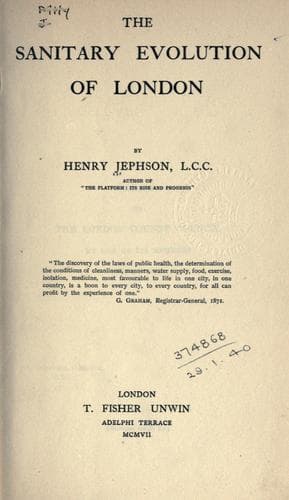
The Sanitary Evolution of LondonJephson, Henry (Henry Lorenzo)
History
The Sanitary Evolution of London
Jephson, Henry (Henry Lorenzo)
Public health -- England -- London
An official representation, that the houses within a particular
area were unfit for human habitation, was to be made to the Central
Authority, the Metropolitan Board of Works, by the Medical Officer of
Health of a Vestry or District Board, and the Metropolitan Board was
empowered to declare the same to be an unhealthy area, and to make an
improvement scheme in respect of it. If it decided that an improvement
scheme ought to be made, it should forthwith make such a scheme, which,
after sundry formalities, was embodied in a Provisional Order which had
to be confirmed by Parliament.
The compensation to be paid for the property so taken might be settled
by agreement between the Metropolitan Board of Works and the owner, but
where no agreement was arrived at, an arbitrator was to be appointed by
the Secretary of State. The arbitrator was to assess the compensation
at the fair market value of the lands concerned, due regard being had
to the nature and then condition of the property, but no additional
allowance was to be made in respect of the compulsory purchase of the
area.
The value settled, and the land having passed into the hands of the
Metropolitan Board of Works, the obligation was imposed on that body
of pulling down the buildings, and selling, or letting, the cleared
ground for the erection of improved dwellings for the same number of
people.
The hardship of working class and poorer persons being turned out of
houses and no other accommodation being provided for them was formally
recognised in this matter, and the scheme had to provide for the--
"Accommodation of at the least as many persons of the working class as
may be displaced in the area ... in suitable dwellings which, unless
there are any reasons to the contrary, shall be situate within the
limits of the same area, or in the vicinity thereof. It shall also
provide for proper sanitary arrangements."
The Act was intended to relieve owners of such property without loss or
benefit, and several representations as to unhealthy areas were made
to the Metropolitan Board. The facts stated in these representations
and subsequently brought out in evidence in the public inquiries held,
were illuminating as to the terrible depths which the conditions of
life of numbers of the people had been allowed to reach, without
the intervention of the law, or the staying hand of the freeholder,
lessees, or sub-lessees, who derived financial profit from the property.
The Medical Officer of Health for Limehouse described one of them:--
"The area, though not large, contained abominations sufficient for
an area three times its size. Here were crowded houses, built no
one knows when; how they stood was a marvel, their walls bulged,
their floors sunk, an indescribable musty odour pervaded them; water
supply, drainage, closets, all were bad, and in my opinion, nothing
could remedy such a state of things short of pulling down the rickety
buildings."
Public-domain text, read in full here on John Shaqi.
Reviews
Reviews
No reviews yet
Be the first to share your thoughts on this work.
Elsewhere in the archive
Join the Discussion
Join the discussion
Sign in to leave a comment or review.
Sign InorCreate an account