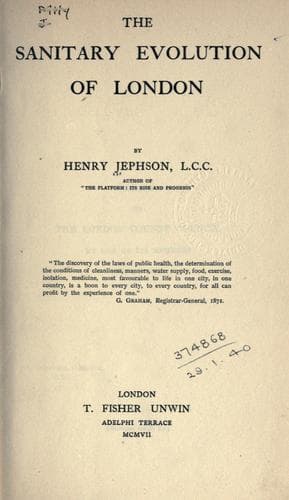
The Sanitary Evolution of LondonJephson, Henry (Henry Lorenzo)
History
The Sanitary Evolution of London
Jephson, Henry (Henry Lorenzo)
Public health -- England -- London
"The Act is almost inoperative. The highly penal nature of this
statute, which in the event of demolition gives no compensation to
the owner whose property is destroyed, makes Courts of Justice extend
every possible leniency to the owner. Moreover it does not contemplate
any scheme for the reconstruction of the houses demolished, or other
provision for population displaced...."
And the Medical Officer of Health for St. James', Westminster, where no
action was taken under it, wrote (1872-3):--
"It is scarcely necessary to say that such an Act could not be acted
upon without the grossest injustice to the owners of property, and the
infliction of the greatest hardship on the poor."
But there was another view, much nearer justice, which was given
expression to before the Select Committee in 1881.
"An owner of property who allowed his property to fall into such a
miserable state as to be unfit for human habitation is not a man that
deserves the slightest consideration of any kind from Parliament--he
ought to be treated rather as a criminal than an owner of property. To
compensate him is a mistake entirely."
And the Medical Officer of Health for Whitechapel said it was his
opinion that--
"If the landlord leaves his house in a very bad state, and will not
listen to any representations, he ought not to be paid by the public
when he is creating a nuisance."
The Act of 1868 having helped so little to a solution of the housing
problem, and the matter being one of ever-increasing urgency, an effort
was made to deal with it in 1875, when a Bill for facilitating the
improvement of the working classes in large towns was introduced into
Parliament by Sir R. A. Cross, and was carried.
It often happened that in some of the worst slums, the houses were the
property of several owners, and it was not therefore in the power of
any one owner to make such alterations as were necessary for the public
health.
The Act[134] of 1875 contemplated--
"Dealing with whole areas, where the houses are so structurally
defective as to be incapable of repair, and so ill-placed with
reference to each other as to require, to bring them up to a proper
sanitary standard, nothing short of demolition and reconstruction.
Accordingly, in this case, the local authority, armed with compulsory
powers, at once enters as a purchaser, and on completion of the
purchase proceeds forthwith to a scheme of reconstruction."[135]
Public-domain text, read in full here on John Shaqi.
Reviews
Reviews
No reviews yet
Be the first to share your thoughts on this work.
Elsewhere in the archive
Join the Discussion
Join the discussion
Sign in to leave a comment or review.
Sign InorCreate an account