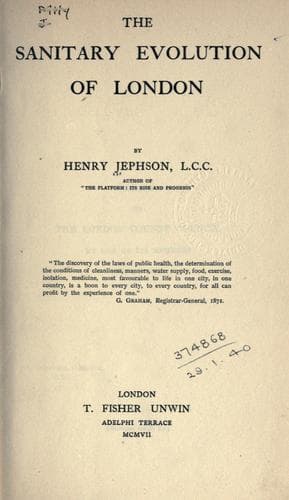
The Sanitary Evolution of LondonJephson, Henry (Henry Lorenzo)
History
The Sanitary Evolution of London
Jephson, Henry (Henry Lorenzo)
Public health -- England -- London
"There is a very large number of interests to be paid for. There is
first the freeholder; then there is the first lessee; then there are
numbers of under-lessees, and all the trades of those little shops, and
they ought all to get something."
And another area was the "Great Wild Street Scheme," in the parish of
St. Giles'-in-the-Fields.[136]
"This area has long been a hot-bed of disease. It contains about 5-1/2
acres, and 227 houses stand upon it inhabited by 3,897 persons.
Great Wild Street 58 houses containing 926 persons.
Drury Lane 31 " " 425 "
Princes' Street 14 " " 315 "
Wild Court 14 " " 346 "
"Many of the courts and passages are approached by a narrow passage
under a house at either end which renders ventilation very defective.
Some of the houses are built close together and have dark passages and
staircases, others have no back yards, and their sanitary arrangements
are placed in the basement. Health under such circumstances is
impossible. This part of St. Giles' has long been noted for its heavy
sick and death rates, especially from diseases of the respiratory and
pulmonary organs, and from typhus fever and other zymotic disorders in
their most contagious forms."[137]
Dr. Lovett, the Medical Officer of Health, stated that diseases were
very rife in it, and a very high rate of mortality as compared with the
number of cases.
And he added, "The district is a nest of zymotic diseases of the most
contagious kind. In 1874, 27 cases of typhus were sent to Stockwell
Hospital. This state of things cannot be dealt with under Torrens'
Act. The houses are built so close together, the people are so huddled
together ... you must make a clean sweep of the buildings."
Another of these insanitary areas was Pear Tree Court, in Clerkenwell,
"consisting of small tenements of an exceedingly inferior description.
All are more or less calculated to engender disease and filth. The
condition of the property has been such as to be a reproach to the
neighbourhood.
"Occupied by the very poorest of the community. When disease made
its appearance it has been fostered and engendered and continued by
the state in which the property and its surroundings have been--the
death-rate is nearly double of that which prevails over the whole
parish.
"Some of the tenements are of the most wretched description--some
constructed of lath and plaster--some wooden houses--the floors rotted
partly by the cisterns, partly by rain coming in.
"In some cases the sanitary convenience is in the very rooms
themselves--also the water-butt--thereby engendering and perpetuating
the worst kind of zymotic disease: the chosen home of fever and also of
smallpox.
"An entire absence of ventilation.
Public-domain text, read in full here on John Shaqi.
Reviews
Reviews
No reviews yet
Be the first to share your thoughts on this work.
Elsewhere in the archive
Join the Discussion
Join the discussion
Sign in to leave a comment or review.
Sign InorCreate an account